Industrial Exhaust and Filtration Technology: Why Clean Air Alone Is Not Enough

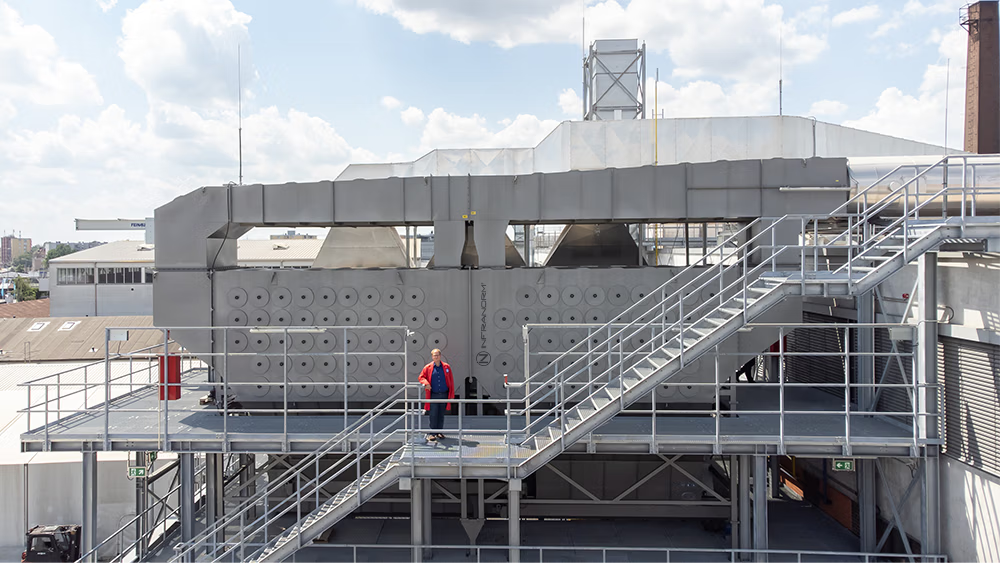
Welding fumes, oil mist, emulsion mist, oil smoke, or dust: Industrial production processes generate airborne emissions that must be reliably captured and removed from the air. The obvious answer is usually a high-performance filtration system. This is precisely where a common misconception begins.
After all, even the best filter can only capture what actually reaches it. The effectiveness of an extraction system is not determined by the filter alone, but by the interplay of capture, airflow, air volume, and filtration. Properly designed extraction and filtration technology therefore influences workplace conditions, process reliability, product quality, and operating costs in equal measure.
KEY FACTS: A HOLISTIC APPROACH TO EXHAUST AND FILTRATION TECHNOLOGY
- High filtration performance alone does not guarantee effective extraction.
- Emissions should be captured as close as possible to their source.
- Capture, airflow, air volume, and filtration must be coordinated.
- The appropriate filtration technology depends on the medium: dust, welding fumes, oil mist, and oil smoke each have different requirements.
- Excessive airflow causes unnecessary operating costs, while insufficient airflow jeopardizes reliable capture.
- Existing extraction systems often offer potential for technical and energy-efficiency optimization.
- The most cost-effective solution is achieved by considering the entire system, not by selecting individual components in isolation.
THE COMMON MISCONCEPTION: A HIGH-PERFORMANCE FILTER SYSTEM SOLVES EVERY EXHAUST PROBLEM
When designing industrial exhaust systems, the focus is usually on technical parameters: air flow rate, filter area, separation efficiency, or fan capacity. These values are important. Taken on their own, however, they do not indicate how effectively the entire exhaust system operates during actual production.
A high-performance filtration system may be combined with an improperly positioned extraction point. Or significantly larger volumes of air may be moved than are necessary for the actual capture of emissions. In both cases, you are paying for technical performance without achieving a better overall solution.
Greater extraction capacity is therefore rarely the answer. The key lies in the proper coordination of the individual system components.
WHY RECORDING AT THE SOURCE IS CRUCIAL
The most effective extraction begins where emissions are generated. If welding fumes, oil mist, or dust are captured directly at the source, they do not spread throughout the production hall in the first place. This reduces the load on the hall’s air and can significantly lower the required airflow rate.
To achieve this, the capture devices, their positioning, the flow conditions, and the production processes must all be properly coordinated. If the extraction system is poorly positioned, emissions first enter the work area and must then be recaptured using large volumes of air. The problem in this case is not an underpowered filtration system, but rather the capture process itself.
Focusing solely on the filter optimizes the end of the extraction chain, not the root cause.
THE RIGHT FILTRATION TECHNOLOGY DEPENDS ON THE MEDIUM
A filter is not a one-size-fits-all component. The appropriate method depends on what needs to be removed and the condition of the emissions when they reach the filter.
Dry Dusts
For dry dusts, cleanable cartridge or bag filters are generally used. For combustible dusts, fire and explosion protection is incorporated into the design from the outset.
Welding fumes
Welding fumes consist of very fine particles that can penetrate deep into the respiratory tract. In addition to a suitable filter medium, capturing the fumes close to the source is particularly crucial. Read more about this in the article Industrial Welding Fume Extraction.
Oil and emulsion mist, oil smoke
Liquid aerosols quickly clog conventional dry filters. Glass-fiber drainage filters, on the other hand, allow the separated oil to drain off continuously and achieve separation efficiencies of up to 99.97%. Read more in the article Oil and Emulsion Mist Filters in Industry.
Sticky and damp dusts
For sticky media, dry dust removal with the addition of hydrated lime can be effective. The hydrated lime binds moisture and oil directly to the filter cartridges, thereby extending their service life.
Even the best separation efficiency is of little use if filter changes and maintenance are not tailored to the actual operating conditions of the system. The article Filter Replacements in Exhaust Systems explains what matters most in this regard.
AIR VOLUME AND ENERGY CONSUMPTION: MORE IS NOT NECESSARILY BETTER
Some industrial exhaust systems move substantial volumes of air. This requires electrical energy. In addition, the exhausted air must be replaced, and this supply air must be heated or cooled depending on the season. Unnecessarily high exhaust capacity therefore drives up operating costs in two ways.
At the same time, the air volume must not be reduced to the point where emissions can no longer be reliably captured. Proper sizing is crucial.
Several factors come into play here:
- Type and quantity of emissions generated
- Location and design of the sampling equipment
- Required air flow rate
- Pressure losses in the piping and filter system
- Operating hours and actual production capacity utilization
- Options for demand-based control
Energy efficiency is not achieved by extracting as little as possible, but by extracting exactly as much as the process actually requires.
WHAT HAPPENS IF THE EXHAUST AND FILTRATION TECHNOLOGY IS NOT SUITABLE FOR THE PROCESS?
An improperly designed extraction and filtration system has an impact on several levels:
Workplace Conditions
If emissions are not adequately monitored, airborne pollutants will spread throughout the work area. This directly affects worker safety.
Process Reliability and Product Quality
In many manufacturing processes, reliable extraction is essential for trouble-free operation. Particles and process residues can also adversely affect manufacturing conditions and, consequently, product quality.
Fire and Explosion Protection
Oil fumes, oil mist, and combustible dusts accumulate in pipes and filters. Without a tailored protection plan, the exhaust system itself becomes a hazard.
Energy Requirements
Excessive airflow, unfavorable pressure conditions, or unregulated fans result in avoidable operating costs.
System Availability
Inadequate maintenance or unsuitable filter elements reduce extraction performance and increase the risk of unplanned downtime.
The technical challenge, therefore, is not to design individual components for maximum performance, but to coordinate their functions with one another.
OPTIMIZE EXISTING EXHAUST SYSTEMS RATHER THAN REPLACING THEM PREMATURELY
Not every existing exhaust system needs to be replaced when production conditions change or the exhaust capacity is no longer sufficient. It’s worth conducting a systematic analysis first:
- Is the emission monitoring system correctly positioned?
- Are the required airflow rates actually being achieved?
- Are the filters, fans, and airflow paths optimized for the current production process?
- What is the status of maintenance and pressure losses?
Depending on the results, targeted adjustments may make more sense than replacement: optimized air intake, modified airflow, demand-based control, or more suitable filter technology. Regular maintenance — such as that provided through Smart Services — ensures the system continues to operate at this level over the long term.
A new system is not automatically the better solution as long as the actual weak point in the existing system has not been identified.
EXHAUST AND FILTRATION TECHNOLOGY AS PART OF THE PRODUCTION INFRASTRUCTURE
Exhaust technology is often viewed as a standalone system. In fact, it is closely linked to the entire production infrastructure. When process air is removed from the facility, it must be replaced. This creates interactions with ventilation, heating, and cooling.
Heat recovery from exhaust air or the recirculation of purified air back into the facility can also improve overall energy efficiency. Whether air recirculation is permissible depends on the substances involved and the applicable occupational safety regulations and must be assessed on a case-by-case basis.
This is precisely where the planning approach THINK INFRANOMIC® from INFRANORM® comes into play: The starting point is the value-added process, not the individual piece of equipment. This is because the greatest efficiency potential rarely arises from a single piece of equipment becoming more efficient, but rather from the systems working together.
EXHAUST AND FILTRATION TECHNOLOGY IN PRACTICE: ITG INDUCTION SYSTEMS
At ITG Induction Systems, INFRANORM® implemented an oil mist extraction system with a flow rate of 8,000 m³/h for an induction hardening line, combined with integrated spark, filter, and duct fire suppression. Extraction, filtration, and fire protection were not designed sequentially but as a single integrated system.
The result: a clean working environment, high process reliability, and long filter service life with minimal maintenance requirements.
CONCLUSION: IT IS NOT THE INDIVIDUAL COMPONENT THAT MATTERS, BUT THE SYSTEM
An industrial extraction and filtration system does not fulfill its purpose simply by having high filtration performance or a large air flow rate. What matters most is whether emissions are reliably captured, efficiently transported, and filtered in a manner appropriate to the medium.
Those who take a holistic view of extraction technology can identify weak points more effectively, avoid unnecessary energy consumption, and create the conditions for reliable production operations.
The crucial question is therefore not: How powerful is our filtration system? But rather: How well does our entire extraction system work?
FAQ
What are the components of an industrial exhaust and filtration system?
Depending on the application, an exhaust system includes collection devices, piping, fans, filter units, and control and regulation technology. It is crucial that all components are tailored to the emissions generated and the production process.
Why is data collection at the source so important?
If emissions are captured directly at the source, they do not spread throughout the facility. In addition, the required air volume — and thus energy consumption — is reduced.
What filtration technology is suitable for oil mist, oil smoke, or welding fumes?
Fiberglass drainage filters, which continuously drain the collected oil, are suitable for oil and emulsion mist as well as oil smoke. For welding fumes and dry dust, cleanable filter cartridges are typically used in combination with source-close collection.
What are the consequences of an improperly sized exhaust system?
A system that is undersized will not reliably capture emissions. An oversized system moves unnecessarily large volumes of air and results in additional energy costs.
How can the energy consumption of an exhaust system be reduced?
Possible measures include optimized data collection, demand-based airflow control, reduced pressure losses, and regular maintenance. Which measures are appropriate depends on the system and the production process.
When should an existing exhaust system be inspected?
Recurring inspections must be conducted at least once a year, but no later than every 15 months. They must also be conducted as needed—at the latest when production processes change, extraction performance declines, energy consumption increases, or the system no longer reliably meets the requirements. In many cases, targeted optimization is more cost-effective than replacement.
Why should exhaust systems be considered in conjunction with building ventilation?
Exhausted air must be replaced. This creates interactions with ventilation, heating, and cooling systems. A coordinated design evaluates air volumes and energy requirements throughout the entire system.