Filter Replacement in Exhaust Systems: When Is It Necessary?

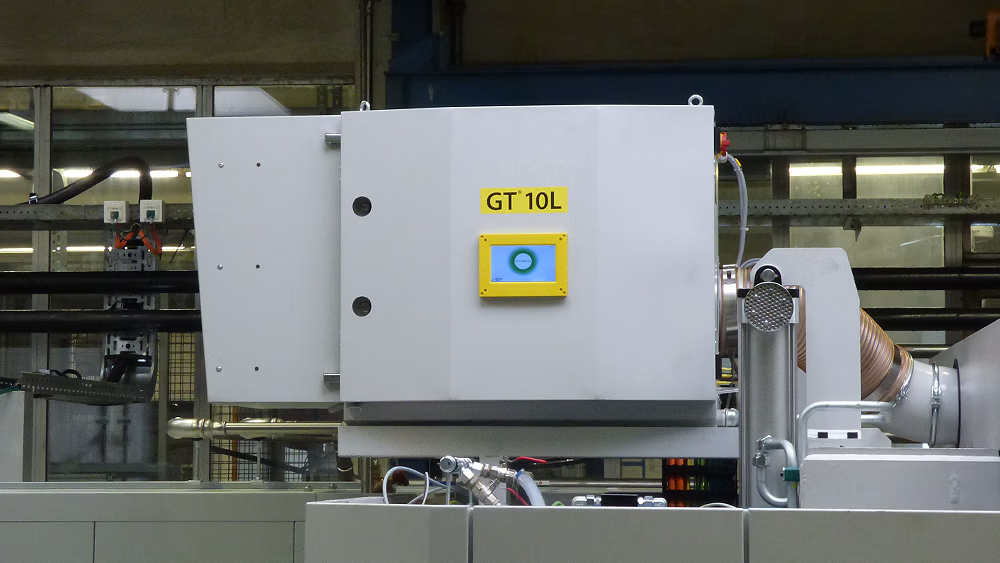
The extraction system is running. Production is running. So the filter is working, too. This conclusion seems obvious, but it doesn’t tell the whole story.
During operation, filter elements continuously capture contaminants from the process air. Depending on the application, these can include, for example, oil mist, emulsion mist, oil smoke, or other particles. As the load increases, the operating conditions of the filter system change. Therefore, the need for a filter change often becomes apparent before the extraction system actually fails.
The key point is not to use a filter for as long as possible. What matters is to use it for as long as is technically feasible and to replace it in a timely manner.
KEY FACTS: PLAN FILTER CHANGES IN ADVANCE
- There is no universal replacement interval for filters.
- A filter’s service life depends on the application and actual load.
- A rising differential pressure may indicate an increasing filter load.
- Declining suction performance or system alerts may also indicate a need for action.
- Condition monitoring allows for filter replacement based on actual need rather than strictly fixed time intervals.
- Timely filter replacement supports reliable system and production operations.
- The replacement filter must be compatible with the system, filter stage, and specific application.
HOW CAN YOU TELL WHEN IT'S TIME TO CHANGE THE FILTER?
A filter should not be replaced solely because a certain period of time has elapsed. How long a filter element can be used depends largely on the actual load.
Key factors include particle size, particle type, particle quantity, the volume of air to be filtered, operating times, and the specific application. Consequently, the service life of filter elements can vary.
Certain factors indicate that the condition of the filters should be examined more closely.
Rising Differential Pressure
Differential pressure describes the pressure difference before and after a filter stage. This value changes as the filter becomes clogged. Therefore, monitoring differential pressure is an important way to assess the condition of a filter system. In systems equipped with the appropriate technology, differential pressure and filter clogging can be monitored continuously. This allows for the early detection of when a filter replacement is necessary and enables better planning of maintenance.
Declining Suction Power
If the extraction capacity changes, one should not automatically focus solely on the fan or the extraction system itself. The filter elements should also be included in the root cause analysis. An increase in filter loading can alter the operating conditions of the entire system.
Equipment and Maintenance Reports
Modern filtration systems can monitor operating hours, filter conditions, and maintenance schedules. Therefore, such alerts should not be taken seriously only after the exhaust system has already been significantly compromised.
THE TYPICAL FALLACY: A FILTER MUST LAST AS LONG AS POSSIBLE
Filters cost money. Changing a filter takes time. Therefore, it initially seems cost-effective to maximize the filter’s service life as much as possible.
However, maximum service life does not automatically mean maximum cost-effectiveness.
This is because the exhaust and filtration system is not an isolated auxiliary unit. In the production environment, it fulfills tasks related to air purification, workplace conditions, process reliability, and product quality. If a necessary filter change is repeatedly delayed, it eventually becomes about more than just the cost of a filter element. It becomes about the reliable operation of the entire exhaust system.
WHAT HAPPENS IF THE FILTER IS CHANGED TOO LATE?
A filter doesn't lose its effectiveness from one minute to the next. The increasing buildup of contaminants develops gradually during operation. That is precisely why the problem is easily underestimated.
The suction power may decrease
As the filter becomes increasingly clogged, the resistance that the air must overcome as it flows through the filter increases. If the required air volume can no longer be reliably directed through the filter system, the collection and removal of contaminated process air may be compromised.
Differential pressure and energy consumption may increase
An increase in filter loading can lead to a higher differential pressure. Depending on how the system is controlled, this may also require more fan power to maintain the required airflow. A loaded filter can therefore affect not only the system’s extraction capacity but also its energy efficiency.
The system is under greater strain
If the system has to operate continuously against increased resistance, the system's operating conditions change. Replacing the filter in a timely manner therefore not only helps maintain air quality but also supports reliable and efficient system operation.
Maintenance can turn into a malfunction
A scheduled filter change can be integrated into production and maintenance processes. If you wait too long, a planned maintenance task can turn into an unplanned intervention.
In the worst-case scenario, production will be halted
If the necessary exhaust ventilation for a production process is no longer ensured, the process may not be able to continue as intended, depending on the application. In the worst-case scenario, a delayed filter change can therefore result in a production shutdown.
This is precisely where the economic perspective shifts: It is no longer the price of the filter that is the decisive cost factor, but rather what depends on its function.
SHOULD YOU CHANGE THE FILTER ON A SCHEDULE OR BASED ON ITS CONDITION?
Fixed maintenance intervals can provide a useful guideline. However, they alone are not always sufficient to determine the actual condition of the filter. This is because two systems of identical design can be subjected to completely different operating conditions. The production process, particle load, operating hours, and air volume all influence the extent to which filter elements are actually stressed.
The crucial question is therefore not just:
“When was the filter last replaced?”
But rather:
“What is the actual condition of the filter under current operating conditions?”
Where appropriate monitoring options are available, factors such as differential pressure, filter load, and operating hours can be incorporated into maintenance planning. This helps prevent filters from being replaced unnecessarily early or dangerously late.
A REPLACEMENT FILTER MUST NOT ONLY FIT THE SYSTEM; IT MUST ALSO BE SUITABLE FOR THE APPLICATION.
If a filter change is necessary, the next question arises: Which replacement filter is the right one?
It is not enough to focus solely on the dimensions. The filter medium and filter stage must be suited to the specific application and operating conditions. Oil mist, emulsion mist, oil smoke, and different particle sizes place varying demands on the filtration process. Technical documentation also distinguishes between different filter media and filter stages for various applications.
A replacement filter should therefore not only fit mechanically into the system but also be suitable for the actual operating conditions.
INFRANORM® offers suitable replacement filters for existing extraction and filtration systems. This also includes replacement filters for GTI® and structurally identical units. The filter or unit designation is usually sufficient for an initial match.
CHANGING FILTERS IS PART OF SCHEDULED MAINTENANCE
Changing a filter involves maintenance effort. However, an unplanned intervention in an extraction and filtration system during production can have significantly greater consequences.
That is why the question should not be:
“How much longer can we use this filter?”
But rather:
“When is the technically and economically optimal time to replace it?”
Regular condition checks and a timely, planned filter change help ensure that the extraction system can reliably perform its function. As part of INFRANORM®’s Smart Services, maintenance measures, technical condition analyses, and spare parts management can be specifically tailored to the system’s operation.
The best time to change a filter is therefore not the latest possible moment, but rather before the filter becomes a problem for the system.
The project at ITG Induktionsanlagen demonstrates the importance of extraction and filtration technology tailored to the process. For an induction hardening system, a solution was implemented to capture oil mist and emissions with integrated fire protection. In addition to a clean working environment, the focus was also on process reliability, long filter service life, and minimal maintenance requirements.
CONCLUSION: IT'S NOT THE PRICE OF THE FILTER THAT MATTERS, BUT WHAT DEPENDS ON IT
A filter element is just one component of an industrial extraction and filtration system. However, its function can be critical to the entire production process. Rising differential pressure, increasing filter loading, declining extraction performance, or corresponding system alerts should therefore not be addressed only after a malfunction has already occurred.
A filter change planned in a timely manner supports extraction performance, system availability, and predictable maintenance.
After all, the goal is not to squeeze every last day of operation out of a filter. The goal is to ensure that the extraction system—and thus production—continues to run reliably.
FAQ
How often do filters in an exhaust system need to be replaced?
There is no universally applicable replacement interval. The service life of a filter depends, among other things, on the application, particle load, air volume, operating hours, and the filter medium used. In addition to maintenance intervals, the actual condition of the filter should therefore also be taken into account.
How can you tell when a filter needs to be replaced?
Indicators may include, among other things, a change in differential pressure, increasing filter loading, decreasing extraction performance, or corresponding alerts from the system control.
What does differential pressure mean for a filter?
Differential pressure describes the pressure difference before and after a filter stage. Monitoring it can help detect changes in filter loading and better determine the maintenance schedule.
What happens if a filter is replaced too late?
Increasing filter loading can alter the operating conditions of the filtration system. Depending on the system and process, this can result in reduced extraction performance, malfunctions, and, in the worst case, impacts on production operations.
Should a filter be replaced at fixed time intervals?
Fixed maintenance intervals can serve as a guideline. However, the actual load is also a decisive factor. Where relevant condition data is available, it can be used to plan maintenance more effectively based on actual needs.
Why is selecting the right replacement filter important?
Filter elements differ in terms of filter medium, filtration stage, and application. A replacement filter should therefore be compatible with both the existing system and the actual process load.
What information is needed to select a replacement filter?
The filter or device designation is usually sufficient for an initial match. Based on this information, INFRANORM® can determine which filter model is suitable for the existing system and application.