Welding fume extraction in industry: requirements, risks and technical classification

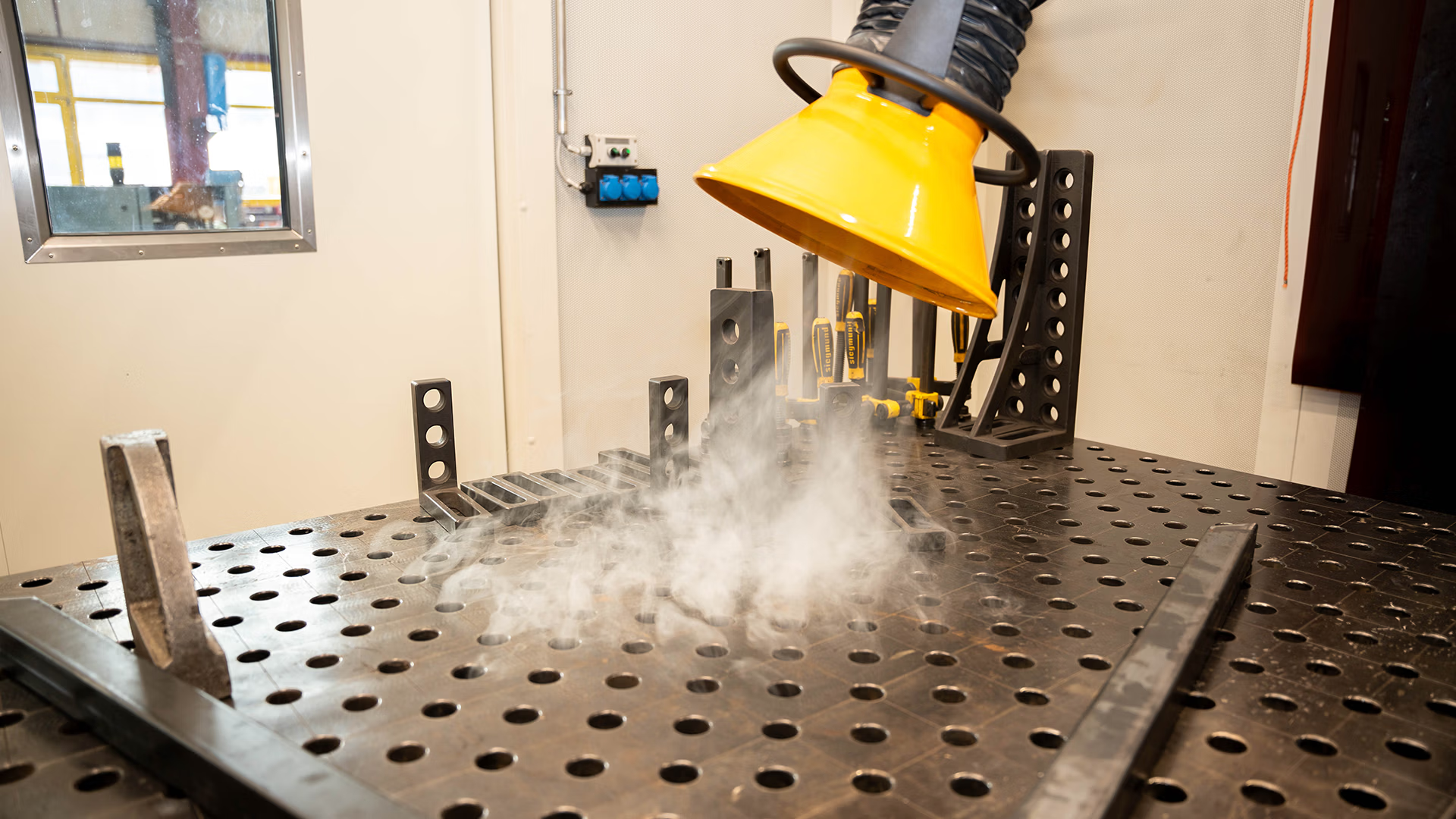
Welding generates emissions that are among the most critical air quality hazards in industrial production environments. Welding fumes contain ultrafine particles and gaseous components that pose risks not only to employee health but also to equipment, processes, and fire safety. A technically sound welding fume extraction system is therefore not an optional add-on but a central component of modern production infrastructure.
KEY FACTS: WELDING FUME EXTRACTION
- Welding fumes consist of ultrafine, respirable particles
- The particles are generated directly at the source and spread rapidly throughout the room
- Room ventilation alone is not sufficient to capture welding fumes
- Effective welding fume extraction requires capture close to the source
- Filter technology, airflow, and system design determine the protective effect
- Worker protection, fire safety, and ATEX requirements must be taken into account
WHAT IS WELDING FUME FROM A TECHNICAL PERSPECTIVE?
Welding fumes are produced by the thermal decomposition and oxidation of base materials, filler materials, and coatings. This process generates particles with diameters often well below 1 micrometer, as well as gaseous components.
These particles:
- are respirable
- remain suspended in the air for a long time
- are difficult to remove by dilution
The composition of welding fumes depends on the process, the materials used, and the process parameters. Typical components include metal oxides, gases, and, in certain applications, substances hazardous to health such as chromium or nickel compounds.
WARUM REINE LÜFTUNG KEINE LÖSUNG IST
A common technical misconception is the belief that welding fumes can be controlled using general workshop ventilation. Ventilation systems are primarily designed to facilitate air exchange and heat removal, but not for the targeted capture of highly concentrated emissions at the source.
From a technical standpoint:
- Welding fumes are produced in localized areas and are highly concentrated
- Dilution begins only after the fumes have spread throughout the room
- Health hazards arise even within the immediate work area
Effective reduction of exposure is therefore only possible through source-based extraction. HVAC systems can help distribute or remove welding fumes, but they are no substitute for extraction technology.
REQUIREMENTS FOR INDUSTRIAL WELDING FUME EXTRACTION
Data collection at the source
The key factor in effectiveness is detecting smoke directly at the source. The greater the distance from the source, the higher the airflow rate and energy consumption must be.
Filtration Technology
Due to the fine particle sizes, multi-stage filtration systems are required. The filter design determines:
- Separation efficiency
- Service life
- Maintenance requirements
- Operational reliability
Airflow and Design
The required flow rates depend on:
- Welding process
- Working position
- Sensing device
- Hall geometry
and must be tailored to the specific project.
Fire Safety and ATEX
Depending on the process and material, welding fumes may contain flammable or explosive components. Depending on the application, additional measures for fire and explosion protection may be required. These must be taken into account during the planning phase.
TECHNICAL SYSTEM VARIANTS
In industrial practice, various approaches are used, including:
- Fixed extraction systems at welding workstations
- Mobile extraction units
- Centralized extraction and filtration systems
- Integrated solutions for automated welding processes
The selection depends on the production layout, flexibility, type of emissions, and operating mode.
INTEGRATION INTO THE PRODUCTION INFRASTRUCTURE
Welding fume extraction is not an isolated system. In modern production facilities, it is increasingly viewed as part of a comprehensive air and energy management system. It interfaces in particular with: ventilation systems, air purification, heat recovery, and overarching hall conditioning concepts.
Through this integration, energy losses can be reduced and operating costs can be lowered in the long term.
SIGNIFICANCE FOR OCCUPATIONAL SAFETY AND SUSTAINABILITY
From the perspective of Worker protection welding fume extraction is essential. At the same time, the technical design significantly influences energy consumption. Correctly dimensioned extraction near the source requires significantly less air volume than downstream room air solutions.
In doing so, it contributes to:
- to minimize the burden on employees
- to reduce filtering and maintenance costs
- Use in an energy efficient way
CONCLUSION: WELDING FUME EXTRACTION AS A TECHNICAL REQUIREMENT
Welding fume extraction is not a comfort system, but a fundamental technical measure for Ensuring occupational safety, process stability and plant availability. Room ventilation alone is not enough to control emissions. For industrial users, this means welding fume extraction early on in the planning of production infrastructure to integrate and consider it as part of a holistic air and energy concept.
FAQ
Why is welding fume particularly critical?
Welding fumes contain ultrafine particles that can penetrate deep into the lungs and are relevant to health.
Is hall ventilation sufficient to remove welding fumes?
No Ventilation is used to exchange air, not to specifically capture highly concentrated emissions at the source.
Where should welding fumes ideally be extracted?
Right at the point of origin, to avoid expansion in the room and significantly improve the energy efficiency of the system.
What role does filter technology play?
The filter technology determines the separation rate, service life, maintenance costs, energy efficiency and operational safety of the plant.
Can welding fume extraction be integrated into existing systems?
Yes In many cases, integration into existing ventilation or hall conditioning systems is possible, provided that the planning and layout are right.