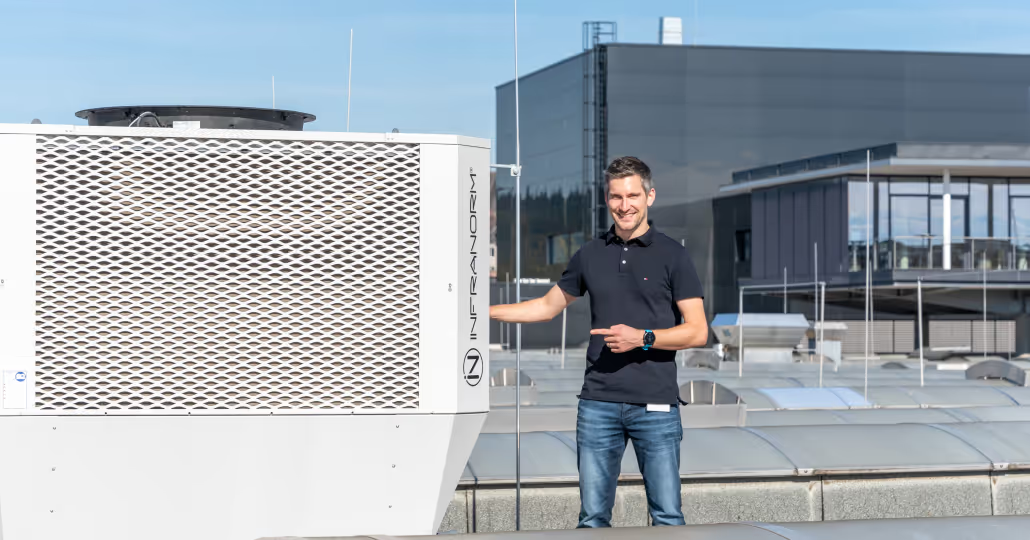
Hall cooling is the new heating. Is your production hall prepared for it?

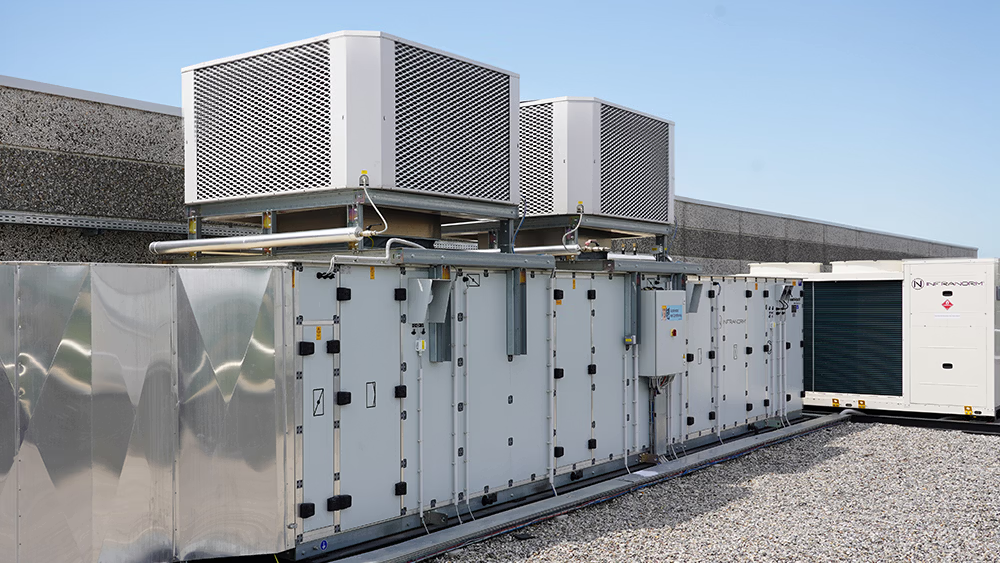
The requirements for production facilities have changed fundamentally. Just a few decades ago, technical building equipment in industrial halls was planned with one primary goal in mind: How can we provide sufficient heat during the winter? Heating systems were considered indispensable, while cooling was usually only provided where production processes strictly required it.
However, this perspective is increasingly out of touch with reality.
Longer heatwaves, rising internal heat loads, and higher productivity demands are fundamentally changing the requirements for industrial buildings. Today, production facilities need more than just protection against the cold. They must create stable conditions for people, machines, and processes all year round.
This is also changing the role of hall cooling. What was once often viewed as a comfort measure is increasingly evolving into a strategic infrastructure for economical and future-proof production operations.
KEY FACTS: WHY HALL COOLING IS INCREASINGLY BECOMING ESSENTIAL INFRASTRUCTURE
- Production facilities are now viewed through a year-round thermal lens.
- Longer heatwaves are increasing the demands on industrial buildings.
- Internal heat loads are continuously rising due to modern production processes.
- Hall cooling boosts productivity and process stability while reducing energy consumption.
- The decisive factor is no longer the individual unit, but the interaction of all technical systems.
FROM A WINTER PROBLEM TO A YEAR-ROUND CHALLENGE
This development is comparable to the shift many industrial companies have already experienced regarding energy supply. In the past, the focus was almost exclusively on the heating season. Today, it is clear that the thermal quality of a building can no longer be viewed on a seasonal basis.
While a few hot summer days previously had little impact on production operations, prolonged heatwaves now regularly lead to an increased burden on employees, machinery, and production processes. At the same time, modern manufacturing facilities generate ever-increasing internal heat loads that must be continuously dissipated, regardless of the outside temperature.
Furthermore, industrial buildings are increasingly being built or renovated for energy efficiency . While a high-quality building envelope significantly reduces heating energy requirements, it can also cause heat (e.g., internal heat loads) to be retained within the building for longer. What is an advantage in winter is becoming an increasing challenge in summer.
Thermal planning therefore no longer ends with the heating load calculation. It must take the entire year into account.
INDUSTRIAL COOLING IS FAR MORE THAN JUST A COMFORT ISSUE TODAY
Thinking of industrial cooling solely in terms of comfortable temperatures is short-sighted.
High indoor temperatures affect numerous areas of a company. They reduce the concentration levels of employees and increase the susceptibility of technical equipment to malfunctions and can compromise the quality of temperature-sensitive production processes. At the same time, energy consumption often increases when machines or additional cooling systems have to operate under unfavorable conditions.
We explain the specific impact of high temperatures on productivity, quality, and profitability, and why heat is often underestimated, in detail in our white paper "Heat in Production Halls".
Industrial cooling is therefore becoming an economic factor. It helps to stabilize production conditions, ensure reliable equipment operation, and optimize energy usage.
The question is therefore no longer whether cooling is necessary, but how this task can be solved as efficiently as possible.
WHY TRADITIONAL APPROACHES ARE REACHING THEIR LIMITS
As temperatures rise, the desire for more cooling capacity often grows. Additional air conditioning units or larger cooling systems seem like the logical solution at first glance.
In practice, however, it becomes clear that high hall temperatures are rarely caused solely by a lack of cooling capacity.
Often, several factors work together simultaneously. Process heat, airflow, ventilation concepts, building geometry, and technical systems all influence one another. If these interdependencies are not taken into account, the installed cooling capacity may increase, but the underlying problem remains.
That is why modern industrial cooling does not start with the selection of a chiller, but with an analysis of the entire system.
What heat loads are actually generated? How does air move through the facility? Where do heat pockets form? Which energy sources can be utilized or recovered? Only once these questions are answered can a sustainable solution be developed.
THE FUTURE BELONGS TO INTEGRATED FACILITY CONCEPTS
The more complex production facilities become, the more important the interaction of all technical systems becomes.
Ventilation, industrial cooling, heating, Process cooling, Heat recovery and building automation can no longer be planned independently of one another. Every decision influences the energy demand and the performance of the other systems.
This shift is already evident in many industrial projects today. Companies are no longer investing exclusively in individual systems, but in holistic conceptsthat equally consider energy efficiency, process reliability, and working conditions.
This is also changing the role of building services engineering. It is evolving from a supporting building system into an active component of value creation.
HALL COOLING IS THE NEW HEATING – BUT DIFFERENT
The comparison with heating primarily describes the shift in significance. For decades, heating was a given. No one questioned that a production hall had to be reliably temperature-controlled in winter. Hall cooling was often only planned for when acute problems arose. This mindset is changing.
More and more companies are realizing that stable conditions in summer are just as crucial for economical operation as a reliable heating supply in winter. However, hall cooling should not simply be seen as the counterpart to heating. While heating systems were often viewed in isolation in the past, the thermal planning of modern industrial buildings requires a holistic approach.
The decisive factor is therefore not the question of which system is installed. The decisive factor is how all systems work together and complement each other.
CONCLUSION: THE PLANNING OF PRODUCTION HALLS IS BEING REINVENTED
The requirements for industrial buildings are continuing to evolve. Energy prices, climate change, increasing process heat, and higher demands on working conditions are changing the way production halls are planned and operated.
Hall cooling is increasingly becoming a fundamental function of modern industrial buildings – just as much a matter of course as heating systems have been for decades.
The real change, however, is not replacing heating with cooling. It lies in viewing buildings holistically. Anyone who understands hall cooling, ventilation, heating, and production processes as interconnected systems creates the foundation for energy-efficient, economical, and future-proof operation.
Because the crucial question today is no longer: How do we heat our production hall in winter? Instead, it is: How do we create optimal conditions for people, machines, and processes 365 days a year?
FAQ
Why is industrial hall cooling becoming increasingly important?
Rising outdoor temperatures, longer heatwaves, and higher internal heat loads are changing the requirements for production halls. Hall cooling helps create stable production conditions while using energy efficiently.
Is a standard air conditioning system sufficient for production halls?
Often not. High temperatures are frequently caused by the interplay of process heat, airflow, the building envelope, and ventilation. A sustainable solution therefore considers the entire hall system rather than just the installed cooling capacity.
What is the difference between hall cooling and hall conditioning?
Hall cooling focuses on temperature control. Hall conditioning also takes into account ventilation, air quality, heat recovery, heating, and the interactions with production processes. The goal is to maintain stable conditions for people and machines all year round.
When should hall cooling be planned?
Ideally, during the design phase of a new building. However, existing buildings also often offer great potential. As part of a retrofit existing systems can be analyzed and optimized step-by-step without replacing the entire infrastructure.
What are the benefits of integrated hall conditioning?
A holistic concept lowers energy consumption, increases process stability, improves the working environment, and makes efficient use of existing energy sources. At the same time, it reduces long-term operating costs.
Is hall cooling only useful for particularly hot regions?
No. Even in Central Europe, more frequent heatwaves and high internal heat loads mean that production halls increasingly require cooling. The decisive factors are the individual requirements of the building and the production processes.