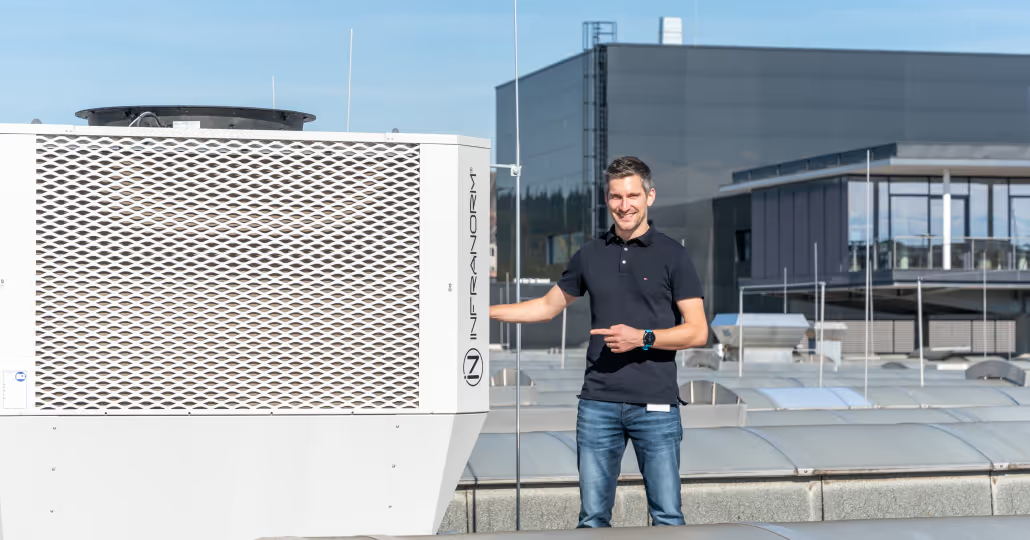
The greatest opportunities for efficiency gains in the industry lie between the systems

Many industrial companies invest millions in new machinery, modern energy technology, or more efficient building systems. Nevertheless, the results often fall short of expectations: individual systems become more efficient, but overall performance improves far less than planned.
The reason often lies not in the systems themselves, but in the connections between production, energy supply, building services, processes, and heat utilization. This is precisely where many energy losses, operating costs, and inefficiencies arise that remain invisible in traditional optimization projects.
KEY FACTS: THE LARGEST LOSSES OFTEN OCCUR AT THE INTERFACES
- Individual systems are frequently optimized, but the interconnections are not.
- Energy losses often occur between processes and infrastructure.
- Waste heat remains unused, even though it is needed elsewhere.
- Production processes and building services are frequently considered in isolation.
- Isolated optimizations can create new inefficiencies.
- Holistic planning improves cost-effectiveness and energy efficiency.
- The future of industrial infrastructure lies in system integration.
THE TYPICAL FALLACY: EFFICIENCY IS SOUGHT IN INDIVIDUAL SYSTEMS
When companies want to increase efficiency, they usually look for optimization potential within individual areas. The production plant should become more efficient, the heating system should consume less energy, the cooling system should operate more effectively, and the energy supply should become more sustainable.
This is understandable. Individual systems are visible, measurable, and clearly identifiable. However, production sites do not function as a collection of independent systems, but often as a complex infrastructure with numerous interactions.
A more efficient machine can create new demands on cooling, ventilation, or energy supply. A modified production line can affect airflows. Waste heat from one process can be valuable elsewhere. A new energy system can lose its effectiveness if it is not integrated into the overall system.
A typical example is process heat: A company invests in a new heating solution while, at the same time, valuable waste heat is discharged unused. Technically, both systems work. From an economic perspective, however, energy is simultaneously being wasted and generated anew.
Those who optimize only individual areas therefore often improve merely a part of the system. The actual potential remains at the interfaces.
WHY INTERFACES OFTEN OFFER THE GREATEST POTENTIAL FOR EFFICIENCY
In industrial production environments, different systems constantly influence one another. Machines generate heat, ventilation systems alter airflows, production processes affect load profiles, and buildings determine thermal conditions. At the same time, energy supply and production interact directly.
Nevertheless, these areas are often planned, evaluated, and operated separately. Production, facility management, energy, maintenance, and building services often each pursue their own goals, metrics, and budgets.
The result is efficiency losses that are not fully visible in any single system. They arise precisely where systems intersect: between process heat and heat utilization, between ventilation and hall climate control, between production planning and energy demand, between building structure and technical infrastructure.
Many companies optimize their systems. However, the greatest losses often occur where no single system is solely responsible.
Those who understand these interfaces often identify greater potential than through the mere optimization of individual systems.
EXAMPLES: WHERE OPPORTUNITIES FOR IMPROVED EFFICIENCY ARE OVERLOOKED IN PRACTICE
A holistic approach often sounds abstract. In practice, however, it manifests itself in very concrete situations.
A typical example is industrial waste heat. In many facilities, valuable process heat is discharged unused. At the same time, additional energy is needed elsewhere to heat buildings, condition fresh air, or support processes. From a technical standpoint, both systems work. From an economic standpoint, however, this results in an avoidable loss.
The situation is similar with ventilation and cooling. If airflow, heat loads, and hall usage are not considered together, additional cooling capacity may be deployed without effectively reaching the relevant work and production areas.
Changes in production layouts can also create new inefficiencies. Machines are relocated, processes expanded, or material flows adjusted. However, building services often remain unchanged. As a result, airflow, heat dissipation, energy supply, or zoning no longer match the actual use of the facility.
Other typical examples include:
- Waste heat is removed while heat is generated elsewhere.
- Ventilation and cooling do not work together optimally.
- Peak loads occur because energy demand and production planning are not coordinated.
- New machines alter thermal loads without the infrastructure being adapted.
- Compressed air, heating, cooling, and electricity are optimized separately, even though they influence one another.
- The building envelope, facility conditioning, and production processes are evaluated separately.
It is precisely these situations that demonstrate why traditional individual optimizations are often insufficient.
HOW COMPANIES CAN IDENTIFY UNTAPPED EFFICIENCY POTENTIAL
Untapped potential isn’t always immediately apparent. It often manifests indirectly through rising operating costs, unstable conditions, or measures that yield less impact than expected.
Typical indicators include:
- Energy consumption barely decreases despite new equipment.
- Individual upgrades yield fewer savings than planned.
- Waste heat is vented, even though heat is needed elsewhere.
- Production and building systems are planned separately.
- New thermal problems or load peaks arise after renovations.
- Cooling, ventilation, or heating systems have to work harder than expected.
- Operating costs are rising even though individual components have become more efficient.
- Departmental silos prevent a system-wide view.
- Data is available but is not analyzed across system boundaries.
Such signs suggest that rather than examining individual systems, the industrial infrastructure should be analyzed as a whole.
Would you like to know where untapped efficiency potential lies within your industrial infrastructure?
WHY TRADITIONAL PLANNING IS INCREASINGLY REACHING ITS LIMITS
Today, industrial companies face significantly more complex challenges than they did just a few years ago.
Energy prices fluctuate. Sustainability requirements are rising. Production processes are changing more rapidly. New technologies are constantly emerging. At the same time, pressure is growing to ensure that investments are cost-effective, flexible, and future-proof.
Under these conditions, it is increasingly rare for it to be sufficient to consider individual trades in isolation. In practice: production versus facilities!
Because every technical decision affects other areas. A new production facility influences energy demand, heat generation, and infrastructure. A new ventilation strategy changes hall conditions and energy flows. An investment in renewable energy is only effective if consumption profiles, storage potential, and production requirements are taken into account.
The crucial question is therefore no longer: How do I optimize a single system? But rather: How do I optimize the entire system?
THINK INFRANOMIC®: UNDERSTANDING INDUSTRIAL INFRASTRUCTURE AS AN INTEGRATED SYSTEM
This is exactly where THINK INFRANOMIC® comes in. The approach views industrial infrastructure not as the sum of individual technologies, but as an interconnected system. The focus is not on machines, ventilation systems, cooling systems, energy systems, or building envelopes in isolation. The focus is on the interconnections between them.
These include, for example:
- Production processes
- Energy flows
- Heat sources and heat sinks
- Airflow
- Building structures
- Utility systems
- Employees and work areas
- Capital and operating costs
- Sustainability goals
Only when these interconnections become visible can solutions emerge that are economically viable in the long term. THINK INFRANOMIC® therefore means: Infrastructure is not only planned technically, but also conceived in terms of economics, energy, and processes.
WHY HOLISTIC APPROACHES ARE AN ECONOMIC FACTOR
At first glance, a holistic approach may sound abstract. In practice, however, it is a very concrete economic lever. This is because decisions are evaluated not only based on the efficiency of individual systems, but also on their impact on the overall system. This shifts the perspective.
A measure is not automatically good simply because a single system consumes less energy. What matters is whether it also stabilizes processes, reduces operating costs, makes better use of existing resources, and takes future requirements into account.
Holistic planning can help to:
- Reduce energy demand
- Lower operating costs
- Make better use of waste heat and resources
- Make processes more stable
- Reduce technical complexity
- Make investments more sustainable
- Make infrastructure more flexible for future requirements
The economic benefit rarely comes from a single technology. It arises from the interaction of the systems.
WHAT DECISION-MAKERS SHOULD CONSIDER BEFORE MAKING NEW INVESTMENTS
Before companies invest in new facilities, additional technology, or major infrastructure measures, it is worth taking a cross-system view.
Important questions include:
- Which systems influence one another?
- Where do energy losses occur between production, buildings, and building services?
- Is there waste heat that can be put to good use elsewhere?
- Do energy supply and load profiles match actual production?
- Do ventilation, cooling, heating, and facility usage work together efficiently?
- Have production processes changed without the infrastructure being adapted?
- Are investments evaluated based on individual costs or on overall impact?
- Which measures improve not just a single system, but the entire system?
These questions help ensure that investments are not viewed in isolation. They reveal where technical, energy-related, and economic effects are interconnected. This is precisely where solutions emerge that not only work in the short term but also have a lasting impact.
CONCLUSION FOR DECISION-MAKERS
Many companies look for efficiency potential where it is most visible: in machines, systems, or individual energy consumers. However, the greatest reserves are often found elsewhere. They lie between the systems.
That is where energy losses, unnecessary costs, and avoidable complexity arise. At the same time, that is often where the greatest opportunities for greater cost-effectiveness, energy efficiency, and sustainability lie.
The future of industrial infrastructure is not decided by individual plants.
It is decided by an understanding of the interconnections. That is exactly what THINK INFRANOMIC® is all about.
FAQ
What does THINK INFRANOMIC® mean?
THINK INFRANOMIC® describes a holistic approach that views industrial infrastructure as an interconnected system. This approach involves analyzing production processes, energy flows, building services, air distribution, and utility systems together.
Why do efficiency losses often occur between systems?
Efficiency losses frequently occur between systems because processes, equipment, and infrastructure are planned and operated separately, even though they influence one another. As a result, potential at interfaces often remains untapped.
What are typical examples of untapped efficiency potential?
Typical examples include unused waste heat, inefficient airflow, unfavorable load profiles, separately planned energy supply, or a lack of coordination between production and building services.
Why are individual optimizations often insufficient?
Individual optimizations usually improve only a specific area. If interfaces, energy flows, and interactions are not taken into account, losses in the overall system may persist or new inefficiencies may arise.
What advantages does a holistic approach offer?
A holistic approach can improve energy efficiency, reduce operating costs, stabilize processes, make better use of existing resources, and make investments more cost-effective in the long term.
For whom is THINK INFRANOMIC® particularly relevant?
For executive management, production management, facility management, technical management, and energy managers who wish to further develop infrastructure, energy, and production in a cost-effective manner.
When should a company conduct a holistic analysis of its infrastructure?
Before major investments, when energy costs are rising, after production changes, in cases of unused waste heat, unstable hall conditions, or when individual efficiency measures have less impact than expected.