Renewing a refrigeration system: When is a retrofit worth it instead of a complete replacement?

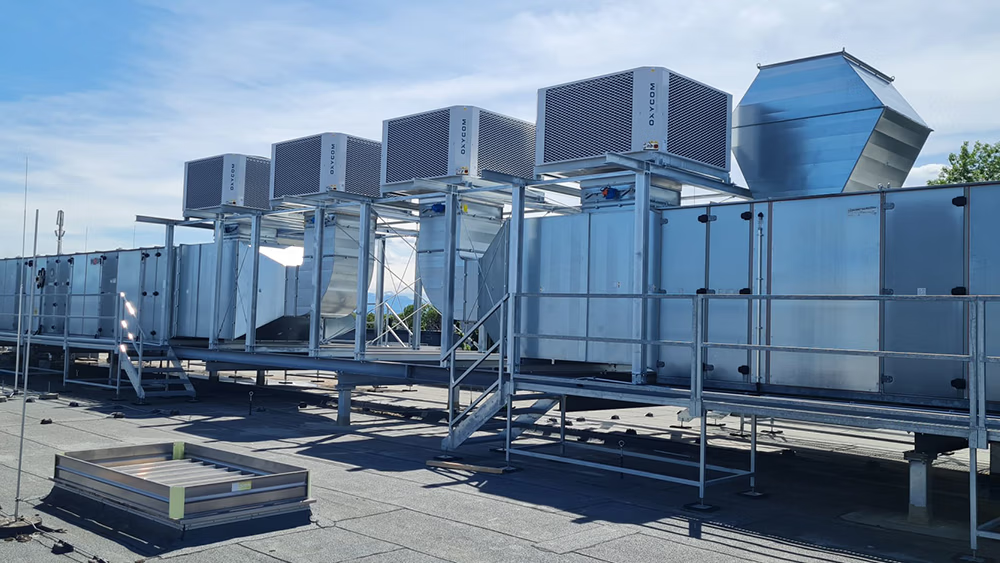
An existing cooling system loses performance in midsummer, electricity consumption rises, and the required cooling capacity can no longer be reliably provided during high outdoor temperatures. For operators, the conclusion often seems clear: the existing system is no longer powerful enough and must be replaced.
This is exactly where it pays to take a closer look. Because the chiller itself is not always the actual problem. The conditions under which it has to operate are also decisive.
Especially at high outdoor temperatures, the thermal load on the cooling system increases. At the same time, it becomes more difficult to release the absorbed heat into the outside air. Instead of hastily replacing functional infrastructure, it can therefore make sense to first improve the operating conditions of the existing system.
The mistake is not in replacing an old cooling system. The mistake is deciding on a full replacement before checking what potential still lies within the existing system.
KEY FACTS: ANALYZE FIRST, REPLACE LATER
- An existing cooling system does not automatically have to be completely replaced.
- As an alternative to a full replacement, precooling can lower the intake temperature of chillers and dry coolers by up to 17 °C.
- More favorable intake conditions can improve cooling capacity and energy efficiency.
- Dry coolers can operate in free-cooling mode for significantly longer with supplementary precooling.
- Existing ventilation systems can be retrofitted with an additional cooling stage, such as two-stage adiabatic cooling.
- Lower thermal stress and fewer full-load operating hours can reduce wear and maintenance requirements.
- Retrofitting allows existing infrastructure to remain in use while specifically improving the areas that limit performance and efficiency.
WHY REFRIGERATION SYSTEMS LOSE PERFORMANCE IN THE PEAK OF SUMMER
Refrigeration systems must release absorbed heat into the environment. The higher the outside temperature rises, the more demanding this task becomes. This is why air-cooled chillers and dry coolers operate under significantly less favorable conditions in midsummer than at moderate temperatures.
This creates a technical dilemma: The refrigeration system is needed most when outside temperatures are high, yet it is simultaneously operating under heavy thermal stress. Power consumption increases while the available cooling capacity drops.
For companies, this can mean more than just higher energy costs. If the required cooling capacity for production processes is no longer reliably available, an efficiency problem quickly becomes a matter of system availability and production security.
The obvious reaction is often to install additional cooling capacity. But before planning a larger or new refrigeration system, another question should be answered: What happens if you change the conditions under which the machine operates instead of changing the machine itself?
THE TYPICAL MISCONCEPTION: MORE COOLING CAPACITY REQUIRES A NEW REFRIGERATION SYSTEM
When an existing chiller no longer achieves the required output, its sizing is often the first thing to be questioned. A larger or more modern system seems to be the logical consequence.
However, this approach is shortsighted if the actual cause lies in the operating conditions.
Therefore, the decision to replace a refrigeration system should not be based solely on the question of how much additional cooling capacity is needed. It is just as crucial to consider the conditions under which this capacity must be generated.
Read more about why additional cooling often only treats symptoms and why the root cause often lies deeper within the system in our article "Industrial Hall Cooling: Are You Cooling the Cause or Just the Symptom?"
This is exactly where retrofitting comes in. Instead of automatically replacing the entire system, we evaluate whether existing infrastructure can be meaningfully supplemented and thereby operated more efficiently.
PRECOOLING: BETTER CONDITIONS FOR YOUR EXISTING CHILLER
One option is to intervene before the chiller itself. With a manufacturer-independent, upstream cooling stage, the intake air is conditioned before it reaches the existing system.
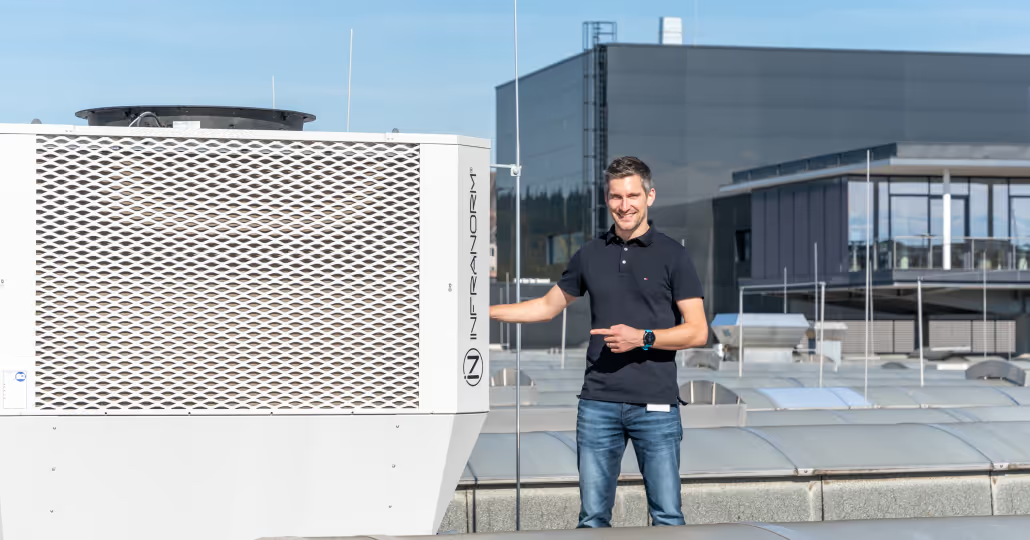
With the technology used by INFRANORM®, the chiller's intake temperature can be reduced by up to 17 °C. As a result, the existing chiller operates under significantly more favorable conditions, even at high ambient temperatures.
This can have two major effects: The system will provide more cooling capacity while simultaneously requiring less electrical energy. Furthermore, lower thermal stress and reduced full-load operating hours have a positive impact on wear, maintenance requirements, and service life.
This approach changes the classic retrofit question. Instead of focusing solely on how to replace an old chiller, we first examine how its existing performance can be better utilized.
RETROFITTING DRY COOLERS: EXTENDING FREE-COOLING USE
This approach is particularly interesting for dry coolers for process or air conditioning cooling.
As long as suitable outdoor temperatures are available, free-cooling, which is cooling using low outdoor temperatures without active compression refrigeration, can be very energy-efficient. If the outdoor temperature rises above the required system conditions, a downstream compression refrigeration system must increasingly take over.
Precooling changes this switch-over point. By lowering the intake temperature, dry coolers can be operated in free-cooling mode for longer. As a result, the more energy-intensive compression refrigeration only needs to be used for fewer hours or at a significantly lower output.
Especially in industrial applications with long operating times, this offers significant potential. It is not simply a matter of generating more cooling, but rather attempting to utilize the existing energy-efficient cooling for as long as possible.
EXISTING VENTILATION SYSTEMS CAN ALSO BE RETROFITTED WITH COOLING
At INFRANORM®, retrofitting is not limited to chillers and dry coolers. Existing ventilation systems can also be upgraded with a cooling function.
This is particularly relevant, for example, if uncooled outdoor air is currently being supplied to the production hall or if an existing ventilation system is being operated with energy-intensive compression cooling.
For suitable systems, an additional cooling stage can be retrofitted without requiring fundamental changes to the existing ventilation unit or control technology. This allows a significant portion of the existing infrastructure to remain in use.
Depending on the initial situation, a retrofit can pursue various objectives: A previously uncooled ventilation system is equipped with a cooling function, or an existing, inefficient cooling system is replaced by a more economical technology.
The principle remains the same: Don't automatically build everything from scratch; instead, intervene precisely where it will have the greatest technical and economic impact.
WHEN IS A COOLING SYSTEM RETROFIT WORTHWHILE?
Whether a retrofit makes sense depends on the existing system and its operating conditions. A retrofit is particularly attractive when the existing infrastructure is fundamentally functional and reliable but reaches its limits under certain operating conditions, such as high outdoor temperatures, increasing loads, or long operating hours.
For dry coolers, it should also be assessed how long free-cooling can actually be utilized. If this period can be extended by precooling, the operating hours of a downstream compression cooling system are reduced.
Another use case arises when additional cooling capacity is required due to production expansion. Before installing a larger chiller, it is worth checking whether the existing system can provide better operating conditions to unlock additional capacity.
Retrofitting is therefore particularly attractive when existing equipment is fundamentally functional, but its potential cannot be fully utilized under current conditions.
WHEN MIGHT A COMPLETE REPLACEMENT BE MORE SENSIBLE?
Retrofitting does not mean keeping existing equipment at any cost. If core components are no longer technically reliable or the existing system structure can no longer meet the future requirements of the production site, a replacement may be the better option.
Also, extensive changes to production processes can mean that an existing system needs to be completely rethought.
The decision should therefore not be based on the principle that "the old must go." Conversely, existing equipment should not be kept simply because it is already there.
The deciding factor is which solution offers the best long-term combination of energy efficiency, performance, system availability, and cost-effectiveness. This is precisely why a systemic analysis is crucial before making an investment decision.
UP TO 95 % LOWER OPERATING COSTS: RETROFITTING CAN PAY OFF QUICKLY
Depending on the initial situation, existing refrigeration and ventilation systems can be optimized through targeted precooling and retrofitting to operate significantly more efficiently. INFRANORM® achieves this with tailored solutions, reducing operating costs and CO₂ emissions by up to 95 %.
The economic advantage is not just a result of lower power consumption. Reduced full-load operating hours, lower thermal stress, less maintenance, longer service life, and higher system availability all have a positive impact on operations.
The specific potential in any given case is assessed through a comprehensive analysis of the existing system and its operating mode. Key factors include cooling technology, operating hours, load profiles, and site-specific thermal conditions.
This is precisely where the strength of a targeted retrofit lies: The investment focuses on areas where performance and efficiency can truly be improved, while existing, functional infrastructure remains in use.
RETROFITTING AS PART OF A HOLISTIC FACILITY INFRASTRUCTURE
A chiller, dry cooler, or ventilation system never operates in complete isolation. True efficiency is achieved through the interaction with production processes, heat loads, airflow, and the site's other technical systems.
These interfaces are often where the greatest untapped efficiency potential lies. We explain why holistic thinking is becoming an increasing economic advantage in the industry in our article "The industry's greatest efficiency potential lies between the systems."
This is why precooling and retrofitting are also central components of Sustainable Hall Conditioning. The modular approach takes existing heating, ventilation, and cooling systems into account and supplements them wherever technical and economic potential exists. In many cases, this means a complete system replacement is unnecessary.
This is exactly where retrofitting differs from simple repair or life extension. The goal is not to keep old technology running for as long as possible. The goal is to further develop existing infrastructure so that it economically meets the future requirements of the production site.
How such modernization and efficiency approaches are implemented in real-world production environments is demonstrated by our best practices from various industrial sectors.
CONCLUSION FOR DECISION-MAKERS
If a refrigeration system loses performance during high outdoor temperatures, consumes more energy, or if additional cooling capacity is required, a complete replacement is not automatically the most economical answer.
Precooling and retrofitting enable a different approach. Instead of prematurely replacing functional infrastructure, operating conditions are improved and existing systems are strategically supplemented. For chillers, a lower intake temperature can improve performance and efficiency. For dry coolers, free-cooling periods can be extended. Existing ventilation systems can be supplemented with efficient cooling.
Therefore, the crucial question is not:
How old is our refrigeration system?
Instead:
How much potential is still hidden in the existing system?
Answering this question before deciding on a complete replacement creates the foundation for an investment that considers technical performance, energy efficiency, and cost-effectiveness together.
FAQ
What does a retrofit mean for a refrigeration system?
Retrofitting refers to the targeted upgrade or further development of an existing refrigeration system. INFRANORM® enhances existing systems, for example, by adding an upstream precooling stage that reduces the intake temperature of a chiller or dry cooler.
When is a retrofit worth it compared to a new refrigeration system?
Retrofitting is particularly attractive when the existing system is fundamentally functional but loses performance at high ambient temperatures, has high energy consumption, or when additional cooling capacity is required. The ability to continue using existing infrastructure can also improve cost-effectiveness.
How does precooling a chiller work?
An upstream cooling stage conditions the outside air before it reaches the chiller. The INFRANORM® technology can reduce the intake temperature by up to 17 °C. As a result, the chiller operates under more favorable thermal conditions, even at high ambient temperatures.
What are the advantages of precooling a dry cooler?
Due to the lower intake temperature, the dry cooler can be operated in free-cooling mode for longer. Consequently, a downstream compression refrigeration system needs to be used later or at a lower capacity. This can reduce energy consumption and operating costs.
Can an existing ventilation system be retrofitted with cooling?
Yes. Suitable existing ventilation systems can be upgraded with a cooling stage. The INFRANORM® solution is designed so that retrofitting is possible without major intervention in the existing ventilation system or control technology.
How much can a retrofit save in operating costs?
INFRANORM® achieves savings in operating costs and CO₂ emissions of up to 95 % with suitable precooling and retrofit solutions. The specific savings potential is determined based on the existing system, its operating mode, and the respective application.
Is a retrofit also possible for existing dry coolers?
Yes. Dry coolers for process and air conditioning cooling can be retrofitted with precooling. The lower intake temperature allows for extended free-cooling operating times and reduces the operating hours of a downstream compression refrigeration system.