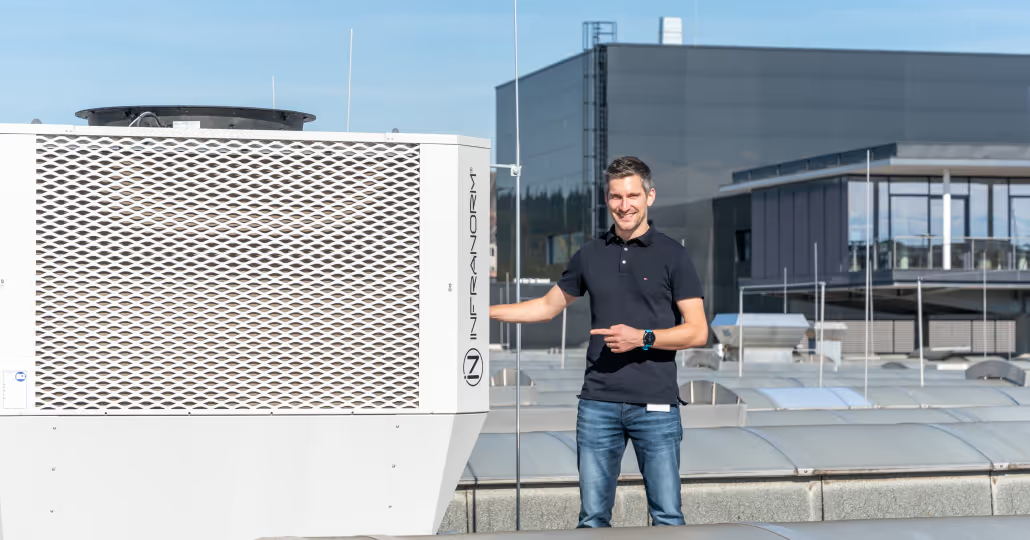
Hall cooling without air conditioning: an alternative to compression refrigeration

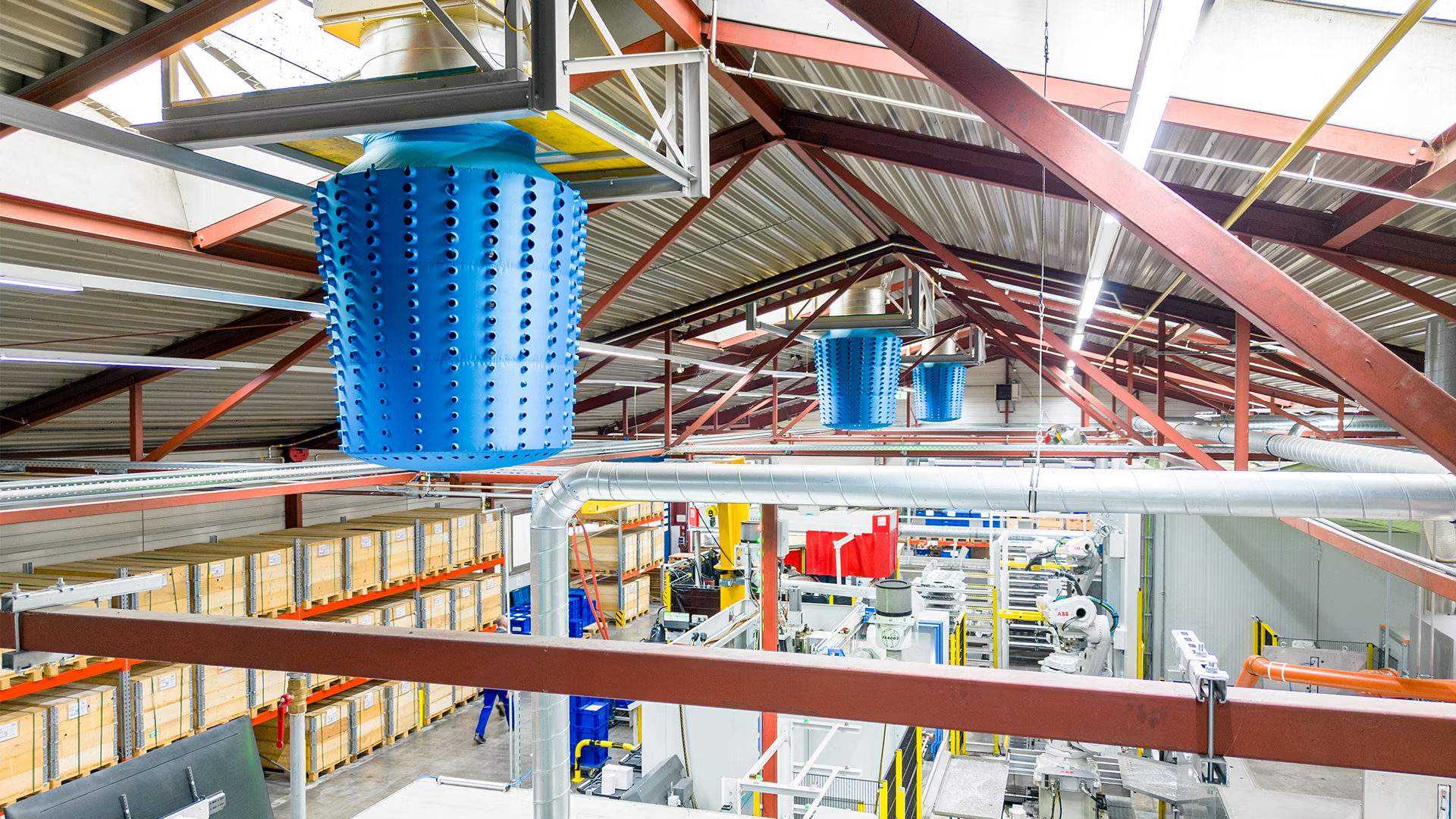
Rising summer temperatures are increasingly causing thermal stress for employees, machinery, and processes in production and industrial facilities. Conventional air conditioning systems based on compression refrigeration often reach their economic and energy-efficiency limits in this environment. Against this backdrop, technical solutions that allow production and industrial facilities to be cooled without the use of conventional compression refrigeration are gaining in importance.
KEY FACTS: HOW TO COOL A HALL WITHOUT AIRCONDITIONING
- Industrial hall cooling without air conditioning refers to cooling concepts that do not rely on traditional compression refrigeration but instead utilize physical principles such as outdoor air circulation and water evaporation
- Adiabatic cooling uses water evaporation as a cooling mechanism and operates without synthetic refrigerants
- Two-stage adiabatic systems enable significantly lower supply air temperatures than single-stage evaporative coolers
- Energy consumption is significantly lower than with conventional industrial air conditioning systems (up to 95 % lower)
- The technology is particularly suitable for large production and logistics facilities with high heat loads
- Hygiene requirements, such as those specified in VDI 6022, must be strictly observed during planning and operation
WHY TRADITIONAL INDOOR AIR CONDITIONING SYSTEMS ARE OFTEN UNSUITABLE
Industrial buildings differ significantly from office or administrative buildings. They are characterized by large air volumes, high internal heat loads, open doors, and continuous air exchange. Compression-based air conditioning systems must deliver very high performance in this environment, which leads to high power consumption and declining efficiency as outdoor temperatures rise.
Added to this are increasing requirements for refrigerants, maintenance costs, and capital expenditures. In many applications, the costs are disproportionate to the actual benefits.
PHYSICAL PRINCIPLES: COOLING WITHOUT A REFRIGERATION UNIT
Alternatives to traditional air conditioning systems do not rely on closed refrigeration cycles. Instead, they utilize the physical effects of air and heat treatment. Key principles include the use of cool outside air, heat removal through water evaporation, and targeted airflow within the building.
The goal is not precise room climate control, but rather the effective reduction of supply air and room temperatures—and thus the perceived room temperature—while significantly reducing energy consumption.
ADIABATIC COOLING AS A COOLING PRINCIPLE FOR INDUSTRIAL BUILDINGS
Adiabatic cooling is based on the evaporative effect of water. As water transitions from a liquid to a gaseous state, it extracts thermal energy from the air. The air cools down without the need for electric compressors or synthetic refrigerants. Technically, a distinction is made between single-stage and two-stage systems.
In single-stage adiabatic cooling, the supply air is directly humidified. The technology is relatively simple, but the achievable cooling capacity is limited. At the same time, the humidity in the hall increases significantly.
Two-stage systems combine upstream sensible pre-cooling with downstream evaporation. This allows for lower supply air temperatures while reducing the introduction of moisture. This approach expands the range of applications, particularly at high outdoor temperatures.
FROM INDIVIDUAL COMPONENTS TO SYSTEM SOLUTIONS
In industrial practice, industrial building cooling without air conditioning is increasingly viewed as a holistic system. In addition to the actual cooling technology, airflow management, airflow control, and control strategies play a central role. In practice, such concepts are often part of integrated industrial building climate control systems that also include heating, ventilation, air purification, and heat recovery.
Typical components of such systems include outside air intake, adiabatic cooling, zone-based air distribution, and demand-based control. Existing ventilation systems can often be integrated into these concepts or retrofitted. Such approaches are now summarized under terms such as sustainable hall conditioning or Sustainable Hall Conditioning.
ADVANTAGES, LIMITATIONS, AND TECHNICAL REQUIREMENTS
The elimination of compression refrigeration offers clear advantages. Electrical energy consumption is significantly lower, there is no need to use climate-damaging refrigerants, and the system design is comparatively simple and robust. At the same time, certain limitations must be taken into account. Cooling capacity depends on outdoor air conditions and is not suitable for applications with very tight temperature and humidity tolerances. Careful design of air volumes and airflow is absolutely essential.
Technical requirements include sufficient available outdoor air, suitable hall geometries, and compliance with hygiene requirements, such as those specified in VDI 6022.
INDUSTRIAL APPLICATION AND PRACTICAL RELEVANCE
Cooling halls without air conditioning makes particular sense where large air volumes are required and/or thermal relief is the primary concern. Typical areas of application include production halls with high waste heat, logistics and assembly halls, as well as industrial manufacturing environments in the metal, plastics, or mechanical engineering industries.
Compared to conventional air conditioning systems, the focus is not on maintaining an exact room temperature, but on creating stable, workable conditions for people and equipment.
IMPORTANCE FOR ENERGY EFFICIENCY AND SUSTAINABILITY
Systems for industrial hall cooling without air conditioning make a significant contribution to reducing electricity consumption and indirect emissions. At the same time, dependence on regulatory requirements for synthetic refrigerants decreases, particularly in connection with F-gases.
However, an objective assessment is important. Adiabatic and outside-air-based systems are not a universal solution, but they offer a technically and energetically sound alternative in many industrial applications when the hall’s conditions and requirements are appropriately taken into account.
CONCLUSION AND TECHNICAL ASSESSMENT
Under suitable conditions, production halls can be effectively cooled without conventional air conditioning systems using compression refrigeration. Modern concepts based on outside air and adiabatic cooling enable a significant reduction in supply air temperature even at high outside temperatures.
For technical decision-makers, this means that not every hall requires an air conditioning system, but rather a properly designed and application-specific cooling concept.
FAQ
What does “cooling a warehouse without air conditioning” actually mean in an industrial setting?
“Hall cooling without air conditioning” means industrial cooling concepts that work without classic compression refrigeration. Instead, outdoor air, physical cooling principles such as adiabatic cooling and targeted air flow are used. The aim is not exact room air conditioning, but the effective reduction of thermal stress in production and industrial buildings with significantly lower energy consumption.
What temperatures can realistically be achieved without air conditioning?
The temperatures that can be achieved depend heavily on outdoor air conditions, system design and cooling technology. Two-stage adiabatic systems can provide significantly cooler supply air than simple evaporative coolers, even at high outdoor temperatures. A flat target temperature does not make sense from a technical point of view; the difference to outside air and the thermal relief in indoor operation are decisive.
What are the limits of hall cooling without air conditioning?
There are limits where very tight temperature or humidity tolerances must be met, for example in certain cleanroom or precision processes. Even with extremely high outdoor humidity, the effectiveness of adiabatic systems decreases. Careful interpretation and realistic goal definition are therefore crucial.
Is adiabatic cooling hygienically safe?
Adiabatic cooling is hygienically manageable when it is professionally planned, executed and operated. Compliance with relevant hygiene guidelines, in particular VDI 6022, is a central requirement. The choice of materials, water supply, drying cycles and maintenance concepts play a central role.
For which types of halls is the concept particularly suitable?
Large production, assembly and logistics halls with high internal heat loads and variable occupancy are particularly suitable. Halls in which classic air conditioning systems would be uneconomical due to the hall geometry or the air exchange rate also benefit from outdoor air-based cooling systems.
Can existing ventilation systems be retrofitted?
In many cases, yes. Hall cooling without air conditioning is often implemented as an extension or retrofit of existing ventilation systems. The prerequisite is that volume flows, air flow and structural conditions permit appropriate integration.
Is hall cooling more energy efficient without air conditioning?
Compared to classic compression refrigeration systems, the electrical energy requirement is generally significantly lower (up to -95%). Since no compressors are used, the power requirement decreases, particularly at high outdoor temperatures. However, actual efficiency always depends on the specific application and interpretation.
Does hall cooling replace any air conditioner without air conditioning?
No It is not a universal substitute, but an application-specific alternative. For the vast majority of industrial applications, it makes more technical sense and is more economical; for others, the classic air conditioning system remains necessary. It is crucial to clearly define the requirements.