Bezirksrundschau Reports on Hall Cooling with Up to 95 Percent Less Energy
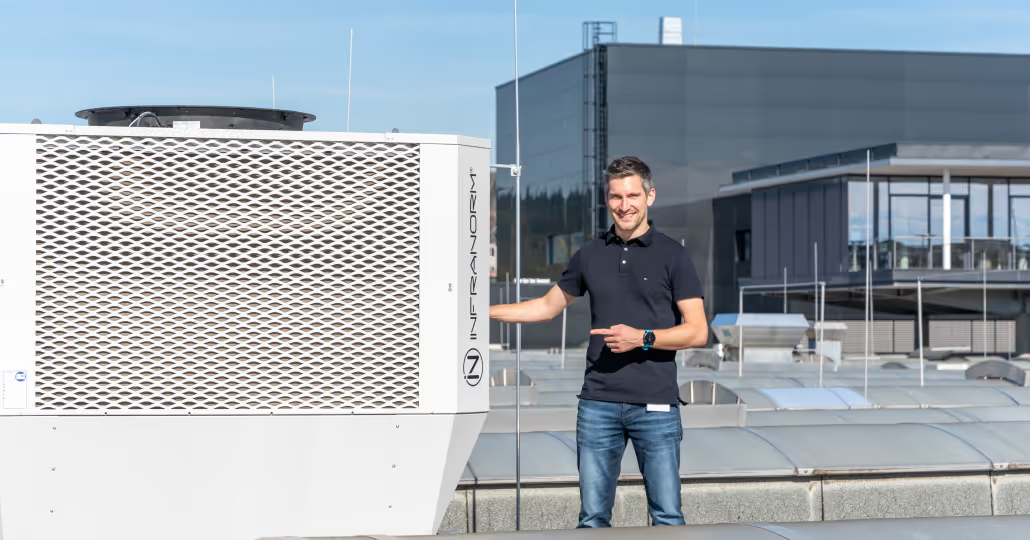
The Bezirksrundschau Wels reports in a current article on an alternative to classic air conditioning for industrial halls. The focus is on a cooling concept from INFRANORM®, which can reduce energy consumption by up to 95 percent compared to conventional cooling systems.
For companies with large industrial, production, and logistics halls, the article provides a practical overview of how modern hall cooling can be implemented energy-efficiently, economically, and reliably, even with rising temperatures.
Key Facts about the Press Article
- Medium: Bezirksrundschau
- Issue: 05/2026
- Technology: Sustainable Hall Conditioning from INFRANORM®
- Publisher's Online Portal: meinbezirk.at/wels-wels-land
The Project in Detail
The publication focuses on how industrial buildings can be efficiently cooled, without resorting to traditional air conditioning systems with high energy consumption. Especially in large-volume production and logistics halls, high temperatures are increasingly becoming a problem: They put a strain on employees, machines, and processes, and can thus also have economic consequences.
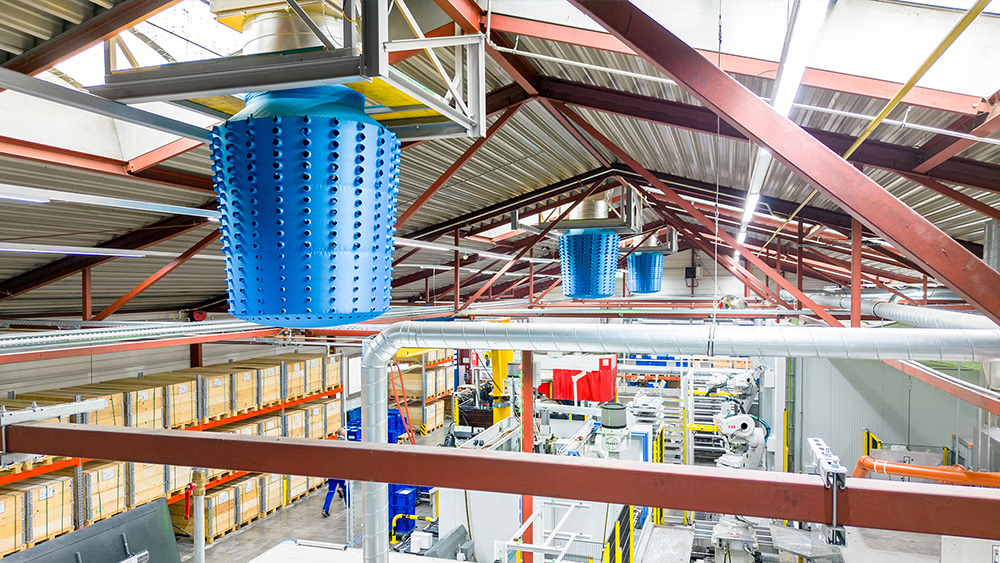
The article explains the working principle of adiabatic cooling clearly: Air is cooled by the evaporation of water. In the solution developed by INFRANORM® developed solution, the air is additionally pre-cooled before it enters the hall. This allows, for example, outside air at 37 °C to be cooled to a supply air temperature of 18 °C.
Sustainable Hall Conditioning addresses this point. The approach combines cooling, fresh air supply, air distribution, and controlled humidity into a complete system. The goal is not just a lower temperature, but a stable hall environment for employees, machinery, and production processes.
Key points of the press article include:
- Alternative to conventional air conditioning: Bezirksrundschau presents the cooling concept as an energy-efficient solution for large industrial, production, and logistics halls.
- Up to 95 percent less energy consumption: According to INFRANORM® energy consumption can be significantly reduced compared to conventional refrigeration systems.
- Adiabatic cooling: The technology uses the natural cooling effect of water evaporation and is, at INFRANORM® , supplemented by additional pre-cooling.
- Up to seven degrees lower temperatures: According to the article, the system can achieve noticeable temperature reductions in industrial halls.
- Controlled humidity: In addition to temperature, humidity is also considered to create stable conditions for machinery and production processes.
- Planning based on specific data: Before implementation, weather data, hall size, and internal heat loads are used to calculate the expected cooling capacity.
Why this approach is relevant for industry
Bezirksrundschau's article shows that Hall Cooling is not only a topic for major trade media but is also gaining increasing regional attention. Especially for an industrial hub like Wels, the question of how production and logistics halls can be operated efficiently and future-proof, despite rising temperatures.
Traditional refrigeration systems in large halls often involve high energy consumption, high operating costs, and additional technical complexity. At the same time, demands for working conditions, process reliability, energy efficiency, and sustainability are increasing.
The approach described demonstrates a clear shift in perspective: Industrial halls are not simply equipped with additional cooling technology, but are conditioned holistically. Sustainable Hall Conditioning views the hall as a functional system – from fresh air supply and air distribution to cooling strategy and operational safety.
For businesses, this means more than just an improvement in indoor climate. Modern hall cooling can help to relieve employees, stabilize production conditions, reduce energy consumption, and align sites more sustainably.
About Bezirksrundschau
Bezirksrundschau reports on current regional topics, including economy, politics, society, events, and local business developments. The platform provides regional news from all over Austria and highlights economic issues at the local level.
The publication shows that energy-efficient hall cooling is perceived as a relevant topic beyond the trade press. For INFRANORM® the reporting is further evidence that sustainable cooling concepts for industrial halls are gaining increasing importance.
The article makes it clear: Anyone who wants to operate industrial halls economically, energy-efficiently, and reliably in the long term must rethink cooling – as part of a sustainable industrial infrastructure.