
Holistic hall conditioning for optimal production conditions at Kansai Helios
At its location in Vienna, Kansai Helios produces liquid paints, powder coatings, synthetic resins, adhesives and other chemicals. The production processes generate high heat loads, further reinforced by solar inputs. The existing plant was unable to sufficiently relieve the load on the halls or ensure air quality. The aim of the project was a modern, energy-efficient overall solution that integrates cooling, extraction, dedusting, heat recovery and process reliability and creates stable production conditions all year round.
Please give your targeting consent to watch this video. By doing so, you agree that when you play the video, data will be transmitted to YouTube and collected by this provider.
Give targeting consent
- sector: Chemicals, pharmaceuticals and medical technology
- customer: Kansai Helios Austria GmbH
- location: Wien, Austria
- category: Sustainable hall conditioning, production infrastructure
- solution: Economical cooling, heat recovery, airing, heating, Indoor air purification, Extraction and filter technology, Utilization of waste heat, Worker protection, Emissions & immission protection, Fire & explosion protection
- KPIs: Fresh air flow rate up to 90,000 m³/h, up to 7 °C lower intake temperature due to two-stage adiabatic cooling, up to 60 % less moisture input, textile air distribution via 15 air channels
- year of execution: 2023
Project details
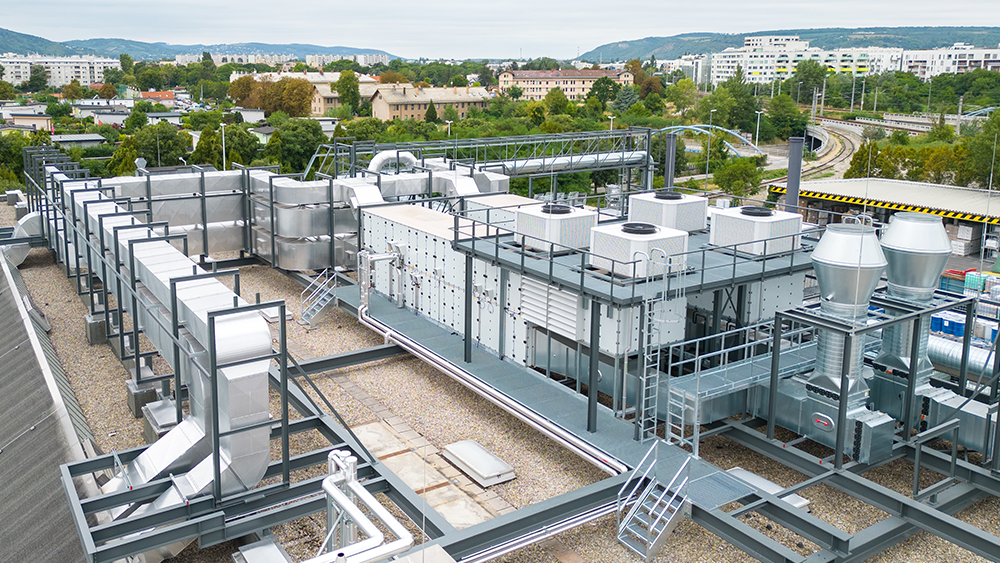
A comprehensive hall conditioning and extraction system was implemented for Kansai Helios, which covers the entire production infrastructure modernized. Three ventilation units, each with 30,000 m³/h, deliver a total of 90,000 m³/h of supply air to the production areas. The air is distributed via 15 textile air hoses and a floor extraction system, which together generate a downward airflow.
Depending on the concentration of solvent and dust, the extraction points are assigned to the respective ventilation units. Air flows containing solvents and dust are purified by an ATEX filter system before thermal afterburning and conducted via heat exchangers to recover heat.
For the cooling of fresh air an adiabatic double stage is used, which enables up to 7 °C lower injection temperatures and up to 60 percent less moisture input compared to simple systems. During the transitional period, heat recovery ensures that no additional heating energy is required.
The result: Significantly better air quality, lower temperature peaks, higher process reliability and stable, energy-efficient operation.
“Improving working conditions for our employees was our top priority. In addition, it was important to us that the dismantling of the old plant and the installation of the new system could take place during ongoing operation. INFRANORM® did this flawlessly and took great consideration. The expertise of INFRANORM® was decisive for our decision. ”

Gerhard Typpelt
Technical Director, Kansai Helios Austria GmbH
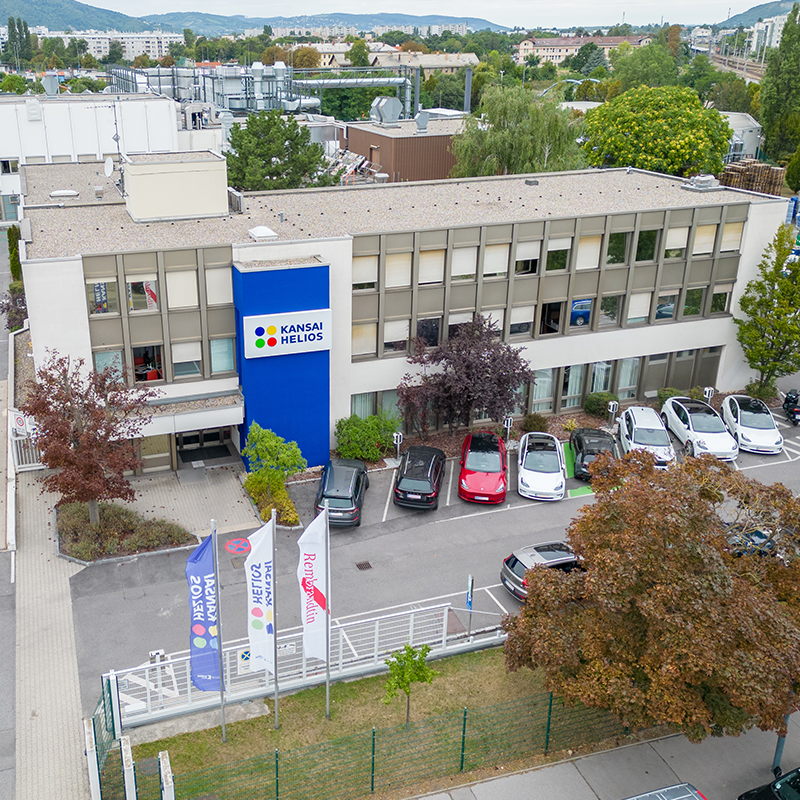
The customer company
Kansai Helios — formerly known as Rembrandtin — has been producing paints, coatings, synthetic resins and special solutions for a wide range of industries since 1937. The Rembrandtin, Thermodur and Kansai Helios brands meet the highest quality and environmental standards. The company is one of the leading manufacturers of industrial paints and electrical sheet paints and has worldwide approvals in the rail vehicle industry.
Learn more about this project
Download the best practice PDF for this project now – simply fill out the form and receive even more information.
synopsis
The project at Kansai Helios shows how holistic hall conditioning sustainably improves production conditions, air quality and energy efficiency. INFRANORM® has successfully overcome the challenge of high heat loads and complex emissions with an integrated system of cooling, dedusting, ventilation, heat recovery and process safety.
The profit for Kansai Helios:
- Total intake air flow 90,000 m³/h
- significantly improved working conditions
- up to 7 °C lower injection temperatures
- up to 60 percent less moisture input
- safe and efficient collection of air containing solvents and dust
- central control of all air conditioning and process air systems
In short: A modern and energy-efficient hall conditioning system for a demanding chemical production site.