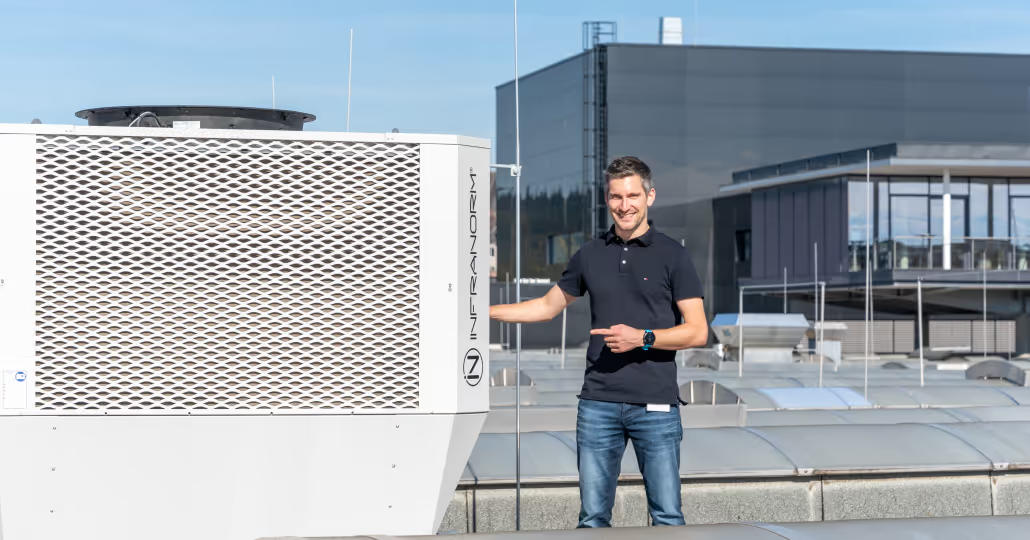
Industrieanzeiger Reports on Cooling Technology That Saves Energy and Reduces CO₂ Emissions
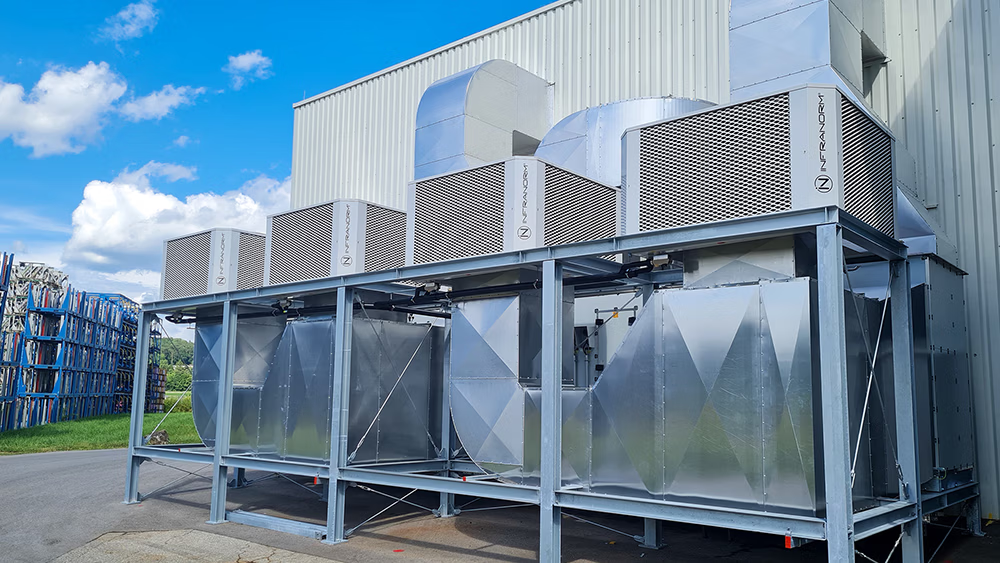
The trade magazine Industrieanzeiger reports in a recent article on sustainable hall cooling and shows how modern cooling concepts can help to energy consumption and CO₂ emissions in industrial halls significantly reduce.
For technical decision-makers in industry, the article provides practical insights into Sustainable Hall Conditioning, adiabatic cooling technology and the question of how production halls can be operated energy-efficiently, sustainably, and reliably, even with rising temperatures.
Key Facts about the Press Article
- Medium: Industry Monitor
- Issue: 06/2026
- Technology: Sustainable Hall Conditioning by INFRANORM®
- Publisher's Online Portal: industrieanzeiger.industrie.de
The Project in Detail
The publication focuses on the question of how industrial halls can be efficiently cooled without unnecessarily increasing energy consumption and CO₂ emissions unnecessarily. Especially in large-scale production environments, rising temperatures affect not only the indoor climate, but also employees, machinery, processes, and operating costs.
The article shows that sustainable hall cooling should not be understood as an isolated cooling solution. Instead, it requires a holistic concept, which considers temperature, air quality, energy consumption, and production conditions together. Sustainable Hall Conditioning addresses this very point and combines Cooling, Fresh air supply, air distribution, and efficiency potentials into an integrated system.
The press article focuses on:
- Energy-efficient Hall Cooling: Modern cooling concepts can significantly reduce energy consumption in industrial halls.
- CO₂ Reduction: Lower energy consumption and the avoidance of traditional refrigeration systems also lead to reduced emissions.
- Sustainable Hall Conditioning: This holistic approach views the entire hall as a functional system – from fresh air supply and air distribution to the cooling strategy.
- Adiabatic Cooling Technology: Evaporative cooling enables energy-efficient temperature control without traditional compression refrigeration.
- Stable Production Conditions: The goal is to maintain constant conditions for employees, machines, and processes – even at high outdoor temperatures.
- Sustainability and Economic Efficiency: The article clarifies that energy-efficient cooling is relevant not only ecologically but also economically.
Why this approach is relevant to industry
This article in Industrieanzeiger addresses a topic that is becoming increasingly important for many industrial companies: How can production facilities be operated reliably and in a resource-efficient manner amid rising climate demands?
Traditional cooling systems in large industrial facilities are often associated with high energy consumption, ongoing operating costs, and additional technical complexity. At the same time, pressure is mounting to reduce CO₂ emissions, lower energy costs, and make production sites more sustainable.
The approach described here shows that cooling should not be viewed merely as a standalone technical solution. Rather, what is crucial is a system that takes the entire facility environment into account and integrates cooling, air quality, energy efficiency, and operational safety.
For companies, this means more than just improving the indoor climate. Sustainable facility cooling can help stabilize production conditions, reduce the workload on employees, lower energy consumption, and achieve climate goals in a cost-effective manner.
About Industrieanzeiger
Industrieanzeiger is a German-language trade publication for decision-makers in the manufacturing industry. The publication covers developments in business, management, technology, production, and industrial infrastructure, and is aimed in particular at CEOs, technical directors, and managers at medium-sized and larger industrial companies.
The article shows that sustainable industrial hall cooling is increasingly being recognized as a strategic issue for the industry. For INFRANORM®, this coverage is further evidence that holistic concepts such as Sustainable Hall Conditioning play an important role in the future of industrial production environments.
The article makes it clear: Anyone who wants to operate industrial facilities in a way that is energy-efficient, sustainable, and reliable in the long term must approach cooling not just from a technical perspective, but from a systemic one.