Eurovent confirms: Evaporative cooling remains efficient even in the face of climate change
As temperatures rise, the demand for cooling capacity in buildings and industrial facilities is growing worldwide. At the same time, a key question arises: Which cooling technologies remain efficient even under changing climatic conditions?
The Eurovent Industry Association published a new brochure in early March that addresses this very question. The report shows that evaporative cooling remains efficient even as outdoor temperatures rise, as its performance depends largely on the wet-bulb temperature.
KEY FACTS: EVAPORATIVE COOLING AND CLIMATE CHANGE
- Rising temperatures are increasing cooling demand worldwide
- Evaporative cooling is based on the wet-bulb temperature
- This rises significantly more slowly than the air temperature
- The technology’s efficiency therefore remains comparatively stable
- Evaporative cooling is considered an energy-efficient solution for industry and commerce
RISING COOLING DEMAND DUE TO CLIMATE CHANGE
With rising temperatures and more frequent heat waves, the demand for cooling is increasing worldwide. Industrial facilities, data centers, commercial buildings, and production halls are particularly affected.
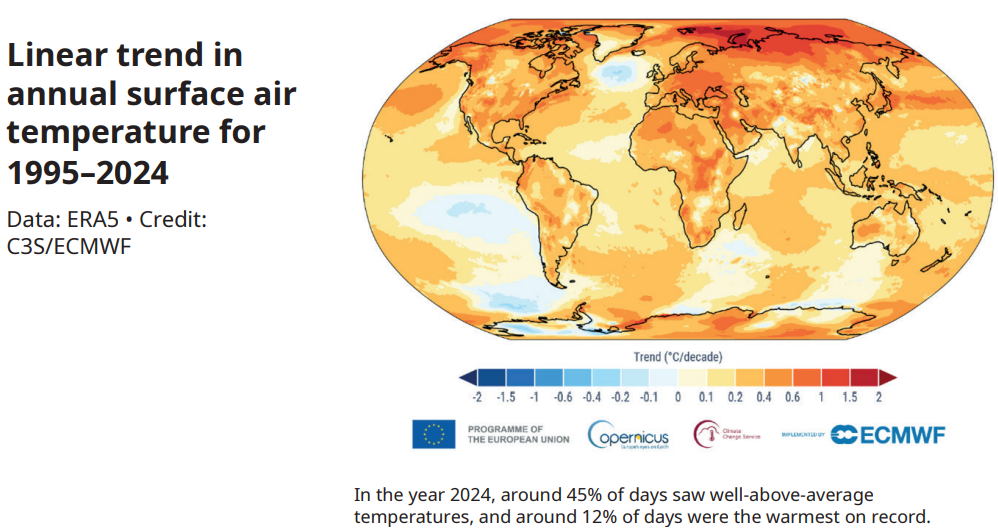
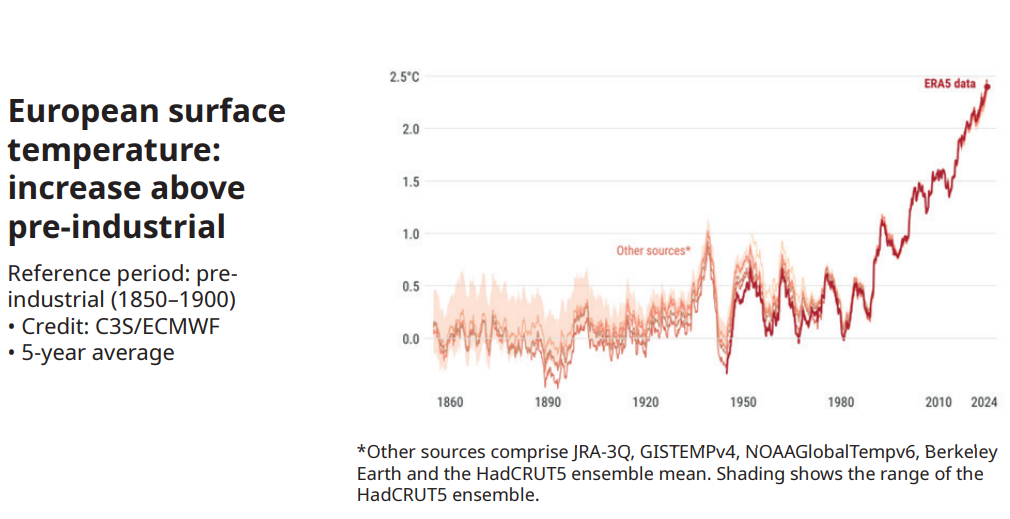
The Eurovent brochure uses various data sets to show that the global average temperature has risen significantly since the 1990s. A clear trend toward higher temperatures is also evident in Europe.
For buildings and industrial processes, this means that cooling is increasingly becoming a central component of energy supply.
A clear trend toward rising average temperatures is also evident in Europe.

WHY EVAPORATIVE COOLING OPERATES WITH PARTICULAR STABILITY
A key point of the Eurovent analysis is the distinction between dry-bulb temperature and wet-bulb temperature.
The dry-bulb temperature corresponds to the standard air temperature that we perceive as the outdoor temperature. Evaporative cooling systems, however, are primarily based on the wet-bulb temperature.
An evaluation of the Eurovent data shows:
- The dry-bulb temperature has risen by about 1.6 Kelvin since 1995
- The wet-bulb temperature, by contrast, has risen by only about 0.7 Kelvin
This difference is crucial. Since evaporative cooling is based on the wet-bulb temperature, its efficiency remains comparatively stable even as air temperatures rise. The 2-stage adiabatic process of the SHC system further enhances this stability and reduces the impact of climate change on cooling capacity and achievable supply air temperatures to nearly zero.
WHAT THIS MEANS FOR INDUSTRY AND BUILDING SERVICES ENGINEERING
Evaporative cooling utilizes physical processes in which water evaporates and absorbs heat from the air in the process. In many applications, this effect is used for adiabatic cooling. This allows for cooling without energy-intensive compression refrigeration.
This technology offers several advantages, particularly in industrial applications:
- low energy consumption
- stable cooling capacity
- lower operating costs
- reduced electrical peak loads
As a result, energy consumption and electrical connected loads can be significantly reduced compared to conventional compression refrigeration systems. Against this backdrop, Eurovent rates evaporative cooling as an “efficient and resilient solution” for the growing demand for cooling.
IMPLICATIONS FOR INDUSTRIAL HALLS
Industrial halls are among the buildings with particularly high heat loads. Production processes, machinery, and large room volumes cause halls to heat up quickly.
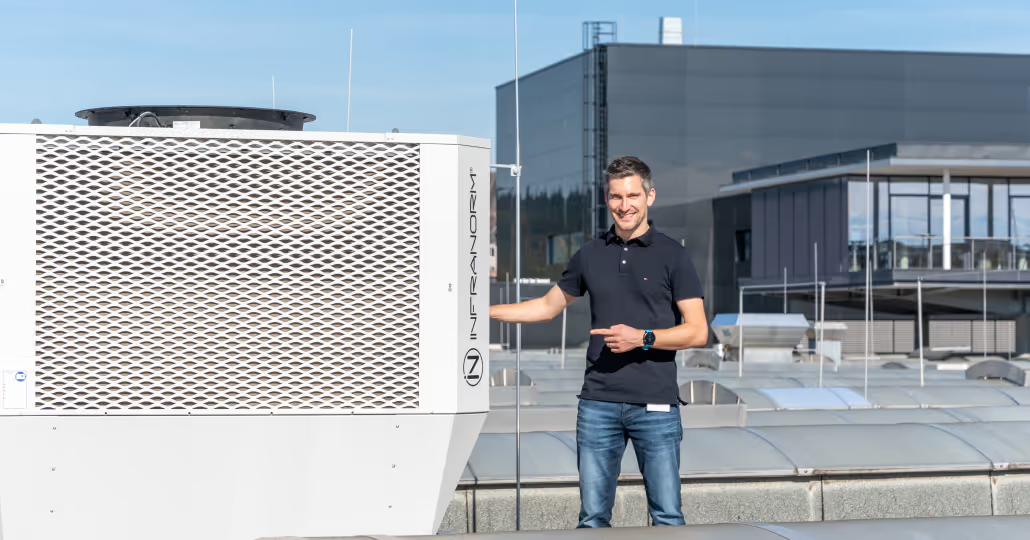
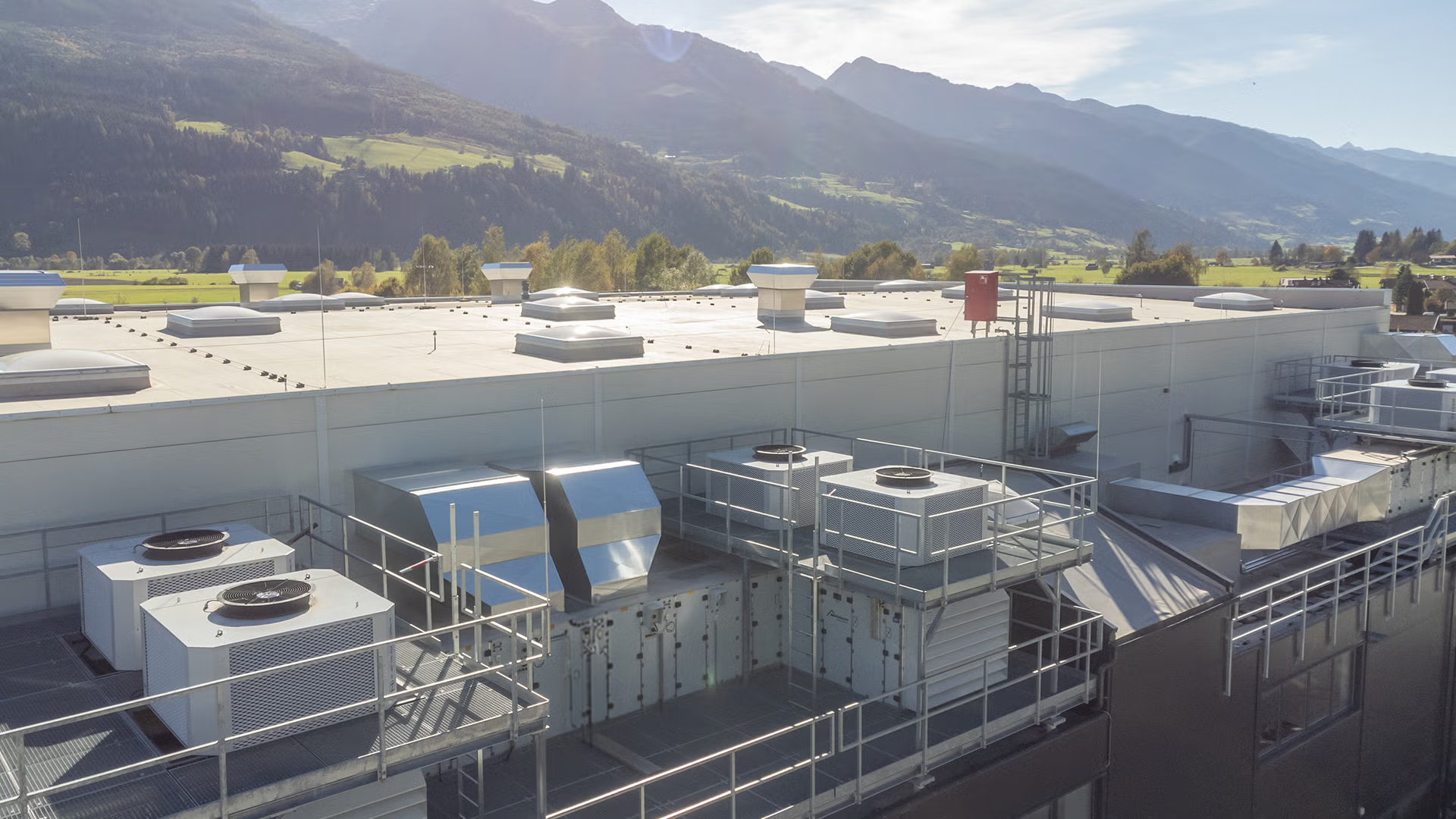
This is where cooling concepts that utilize natural physical processes are gaining importance. Systems such as Sustainable Hall Conditioning combine fresh air supply with two-stage evaporative cooling and enable energy-efficient temperature control of industrial halls.
This allows for a significant reduction in the use of conventional refrigeration systems.
CONCLUSION: EVAPORATIVE COOLING REMAINS A KEY TECHNOLOGY
The Eurovent report clearly shows: Even under changing climatic conditions, evaporative cooling remains an efficient and stable technology. Since its performance depends more on the wet-bulb temperature than on the dry-bulb temperature, its efficiency remains comparatively constant. The SHC system’s two-stage adiabatic process even cools below the wet-bulb temperature of the outside air, thereby ensuring even more stable efficiency than single-stage adiabatic cooling systems, despite climate change.
For industry and building services engineering, this means:
Physically based cooling concepts will therefore play a central role in energy-efficient building and industrial climate control in the future.
FAQ
Why does evaporative cooling remain efficient in the face of climate change?
The technology is based on the wet-bulb temperature, which rises significantly more slowly than the air temperature.
Where is evaporative cooling used?
Typical applications include cooling towers, recoolers, and cooling systems for industrial halls and commercial buildings.
What are the advantages of evaporative cooling?
It requires significantly less electrical energy than conventional compression refrigeration and reduces operating costs.
What is the difference between dry-bulb and wet-bulb temperatures?
The dry-bulb temperature corresponds to the normal air temperature. The wet-bulb temperature describes the lowest temperature that can be achieved through evaporation.