Adiabatic cooling and water consumption: Why the overall balance is what matters

When hall cooling is evaluated, direct and indirect resource consumption are often compared. This is exactly where misinterpretations often arise. Adiabatic cooling requires water directly on-site. Conventional chillers require significantly more electrical energy to operate. Both systems consume resources, but at different points in the overall system. Therefore, it is not enough to simply look at the local water meter. The overall balance is what matters: Water, electricity, CO₂, operating costs, refrigerant risks, and local availability must be evaluated together. The crucial question is therefore not whether adiabatic cooling requires water. That is technically clear.
The truly relevant question is:
Which cooling solution provides the better overall balance for the specific site?
This distinction is crucial when industrial companies evaluate hall cooling not just in terms of investment costs, but also in terms of energy efficiency, CO₂, operating costs, and future-proofing.
KEY FACTS: VISIBLE CONSUMPTION IS NOT THE WHOLE TRUTH
- Adiabatic cooling uses water directly on-site.
- Conventional chillers result in indirect water demand due to their higher electricity requirements.
- The local water meter only shows part of the resource balance.
- An INFRANORM® comparative calculation for 90 kW of sensible cooling capacity shows: compression cooling requires around 300 L/h of total water, while two-stage adiabatic cooling requires around 100 L/h.
- In adiabatic cooling, water is not a blind spot, but a planning parameter.
- The decisive factors are site data, cooling load, operating hours, water availability, and system comparison.
- A blanket assessment of individual consumption values is insufficient for industrial hall cooling.
WHY WATER CONSUMPTION IN HALL COOLING NEEDS TO BE RE-EVALUATED
Production halls are getting hotter. This is not only due to rising outside temperatures, but also due to higher internal heat loads, denser machine layouts, and automated processes. Consequently, the hall climate is no longer just a comfort issue. It affects working conditions, process stability, quality, and operating costs. At the same time, companies are under pressure to reduce energy consumption and CO₂ emissions. Traditional compression cooling can quickly reach economic and regulatory limits here. It requires high electrical power, uses refrigerants, and incurs ongoing operating and maintenance costs.
Adiabatic cooling takes a different approach: It uses water as a cooling medium and generates cooling through evaporation rather than a power-intensive compression cycle. This significantly reduces electricity demand.
Visible water consumption remains a relevant topic. However, it must not be evaluated in isolation.
THE TYPICAL FALLACY: PITTING ON-SITE WATER AGAINST ELECTRICITY DEMAND
Many comparisons between adiabatic cooling and traditional chillers follow a simple pattern: adiabatic systems consume water. Chillers consume electricity. The conclusion seems obvious: you have to choose between water and energy.
That is exactly where the fallacy lies.
Electricity consumption is not resource-free. If significantly more electricity is required to generate cooling, indirect ecological and economic effects arise. These include CO₂ emissions, grid loads, operating costs, and also indirect water demand, for example through cooling processes in thermal power plants.
Adiabatic cooling makes water consumption visible. Traditional compression cooling shifts part of its resource impact upstream to electricity generation.
A fair comparison must therefore consider the entire system.
1. Local consumption
How much water or electricity is required directly on-site?
2. Indirect resource consumption
What consumption occurs off-site due to energy generation or upstream systems?
3. Overall impact
How do the systems perform in terms of water, energy, CO₂, operating costs, refrigerants, and supply security?
Only then does a simple consumption comparison become a reliable basis for decision-making.
HOW ADIABATIC COOLING WORKS
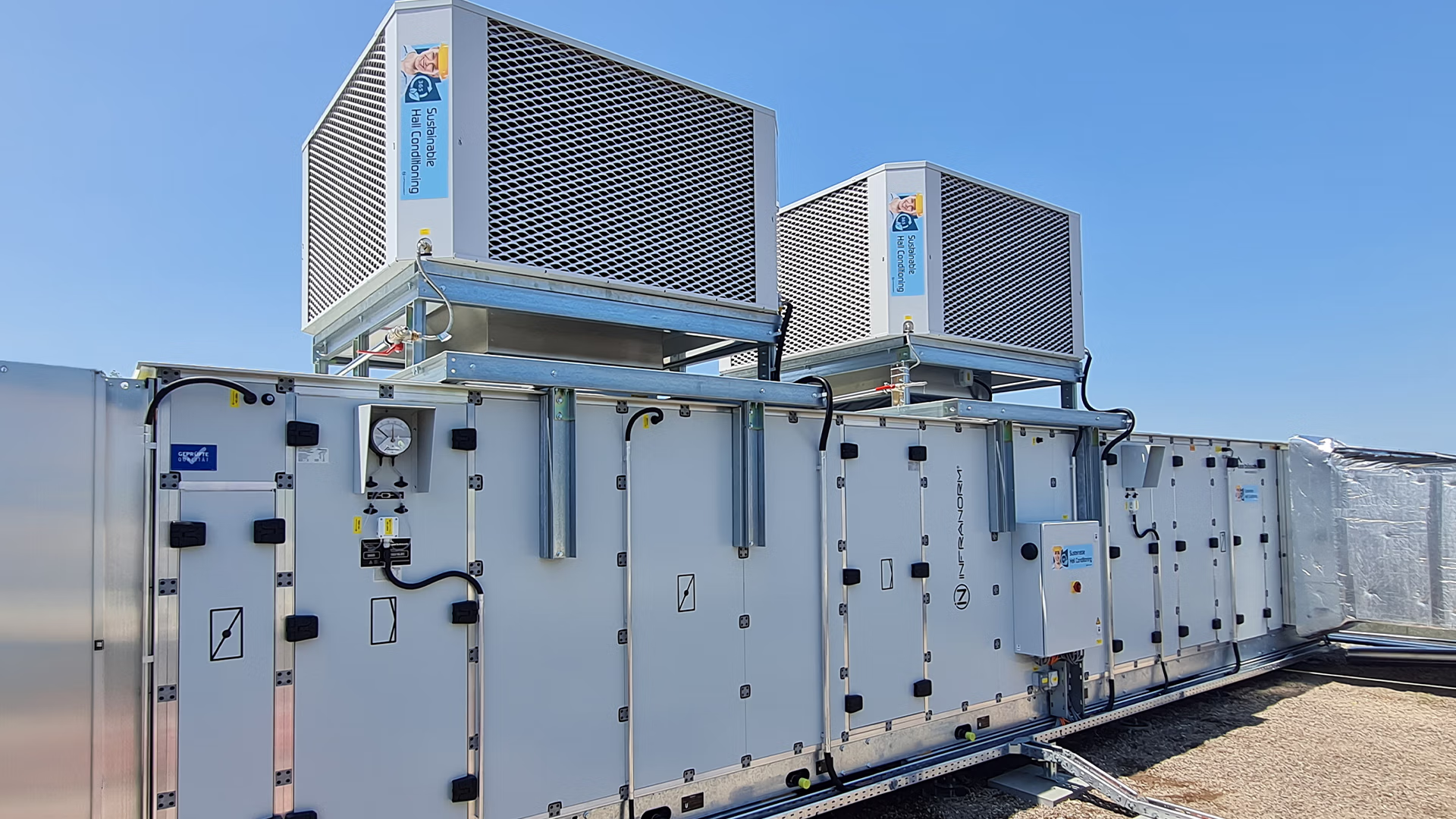
Adiabatic cooling uses evaporative cooling. When water evaporates, it extracts heat from the air, causing the air temperature to drop. This process does not require mechanical refrigeration via a compressor; instead, it primarily uses electrical energy for air and water transport. However, single-stage adiabatic systems involve a trade-off: the more cooling provided, the higher the humidity rises. As a result, a facility may become cooler, but also more humid and uncomfortable.
Two-stage adiabatic cooling resolves this trade-off differently. The outside air is first pre-cooled indirectly and dryly. This lowers the temperature without adding moisture to the air. Direct adiabatic cooling is applied only in the second stage. This allows for lower temperatures to be achieved while limiting the increase in humidity.
This is the crucial difference: It is not about simple evaporation. It is about controlled hall conditioning using temperature, humidity, airflow, and control concepts.
ADIABATIC COOLING VS. CHILLER: WHAT DOES THE WATER COMPARISON SHOW?
An INFRANORM® comparative calculation for an identical sensible cooling capacity of 90 kW clearly demonstrates the difference between traditional compression cooling and two-stage adiabatic cooling.
The conclusion is clear: Two-stage adiabatic cooling requires water directly on-site. At the same time, traditional chillers result in indirect water demand due to their significantly higher electricity consumption. In the overall balance shown, the total water demand of two-stage adiabatic cooling is about one-third that of compression cooling.
This changes the perspective. It is not just the visible consumption that matters, but the system balance.
WHY WATER REMAINS AN IMPORTANT PLANNING PARAMETER
The overall balance generally favors adiabatic cooling. Nevertheless, local water availability remains relevant. Especially in areas with sensitive water supplies, transparency is crucial: what volume of water is actually needed, when peak consumption occurs, and how this demand can be integrated into the overall concept.
This is not an argument against adiabatic cooling. It is a component of professional planning. Water must be evaluated early in the project, just like power supply, roof space, heat loads, air volumes, noise, hygiene, and operational reliability.
Concrete site data is decisive:
- local weather data
- outdoor temperatures and humidity
- actual operating hours
- hall cooling load
- fresh air requirements
- hall volume
- water availability
- potential municipal framework conditions
- comparison with alternative cooling systems
A blanket statement would be unprofessional. A location with ample water availability must be evaluated differently than one with seasonal restrictions. A hall with a high demand for fresh air must be evaluated differently than one with very strict humidity limits. Therefore, water is not a blanket exclusion criterion. Water is a technical and economic planning parameter.
WHAT COMPANIES SHOULD EXAMINE IN AREAS WITH SENSITIVE WATER SUPPLIES
For locations with sensitive water supplies, a blanket rejection is not necessary; what is needed is a reliable site assessment. The decisive factors are how much water is required under real operating conditions, when peak consumption occurs, and which alternatives are technically, economically, and environmentally viable.
Maximum and average water demand
It is not just annual volumes that are relevant, but also realistic consumption peaks on hot days.
Temporal distribution of consumption
Water demand arises primarily when cooling is actually needed. Therefore, operating hours, weather data, and cooling loads are considered together.
Comparison with the alternative
A conventional chiller avoids local evaporative water consumption, but results in higher electricity demand, higher operating costs, and refrigerant risks.
Control strategy
Modular operating modes, free cooling, night ventilation, or zone-based conditioning can be used to precisely manage resource consumption.
Site approval
In areas with sensitive water supplies, it is important to clarify early on which local regulations apply and how the actual demand should be technically assessed.
Alternative water sources and water treatment
Where local water availability is limited, alternative supply concepts can be considered. INFRANORM® offers standardized water treatment solutions for this purpose. Depending on the site, collected rainwater or other suitable water sources can be treated and used for adiabatic cooling. This makes it possible to reduce reliance on public water supplies in a targeted manner, turning uncertainty into a solid basis for decision-making.
BRP-ROTAX CASE STUDY: WHY PROJECT CONTEXT IS DECISIVE
The INFRANORM® reference project at BRP-Rotax demonstrates the importance of the specific context. Over a ten-month measurement period from June to March, a total water consumption of 2,770 m³ was recorded. This equates to approximately 107 m³ per cooler over ten months. Extrapolated to a full year, this corresponds to approximately 140 to 160 m³ per cooler.
At the same time, compared to the previously used well-water cooling system or an alternative well-water heat pump, approximately 250,000 m³ of well water were saved annually. Additionally, the project reduced electricity consumption by around 1.2 GWh and CO₂ emissions by approximately 250 tons per year.
This example shows: A system may require water during operation and yet still contribute to a significant reduction in overall water consumption within a specific project.
It is not the technology label that matters, but the initial situation.
CONCLUSION: ADIABATIC COOLING AND WATER CONSUMPTION MUST BE EVALUATED SYSTEMICALLY
Adiabatic cooling uses water as a cooling medium. That is technically clear. However, the visible water consumption on-site is not the whole story. Conventional chillers require significantly more electricity, resulting in indirect resource consumption that is often overlooked in comparisons. Anyone seriously evaluating hall cooling must therefore look beyond a single consumption value. The decisive factor is the overall balance of water, energy, CO₂, refrigerant risks, operating costs, and local availability. With adiabatic cooling, water is not an argument against the technology. Water is a planning parameter. Better hall cooling is achieved by focusing not on individual consumption values, but on understanding the entire system.
FAQ
Does adiabatic cooling consume water?
Yes. Adiabatic cooling uses water for evaporation. This extracts heat from the air, which lowers the temperature. Water consumption occurs directly at the site and must be calculated on a project-specific basis.
Does adiabatic cooling consume more water than a chiller?
Only if you look exclusively at the water meter on-site. The overall balance presents a different picture: adiabatic cooling uses water directly in the cooling process, whereas conventional compression cooling results in indirect water consumption due to its high electricity demand. An INFRANORM® comparative calculation for 90 kW of sensible cooling capacity shows a total water requirement of around 300 L/h for compression cooling compared to around 100 L/h for two-stage adiabatic cooling.
Is water scarcity an exclusion criterion for adiabatic cooling?
Water scarcity does not automatically mean that adiabatic cooling is ruled out. The decisive factor is a site-specific assessment: actual water demand, peak consumption, local supply situation, operating hours, and a comparison with alternative cooling systems are all considered together.
Why is looking at the water meter not enough?
Because it only shows local consumption. Conventional chillers shift part of their resource impact upstream to electricity generation. For a fair assessment, local and indirect resource consumption must be considered together.
What is the difference between single-stage and two-stage adiabatic cooling?
Single-stage systems cool directly through evaporation, which increases humidity more significantly. Two-stage systems first pre-cool the outside air indirectly and dryly. This is followed by direct adiabatic cooling. As a result, lower temperatures can be achieved while limiting the increase in humidity.
Is adiabatic cooling always better than compression cooling?
The best solution depends on the specific site. Key factors include the climate zone, building type, heat load profile, target temperatures, water availability, electricity costs, and existing infrastructure. That is precisely why a project-specific assessment is more effective than a one-size-fits-all technology decision.
What role does Sustainable Hall Conditioning play in this context?
Sustainable Hall Conditioning views industrial cooling as an integral part of the production infrastructure. Temperature, humidity, fresh air, energy, water, waste heat, and operational reliability are evaluated holistically, rather than treating cooling as an isolated, standalone system.