
Hybrid cooling at Ceramdis GmbH in Elsau
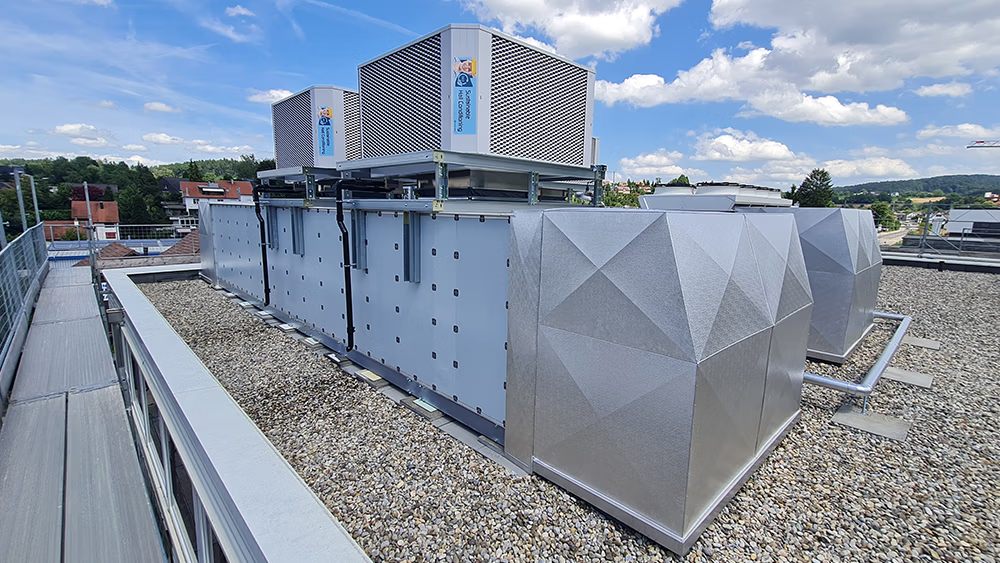
At Ceramdis, extruders and sintering furnaces generate high internal heat loads, while CNC manufacturing requires stable temperatures. Following the hot and humid summer of 2023, the goal was to maintain a maximum of 25.5 °C and 65 % relative humidity year-round. INFRANORM® therefore upgraded the existing Sustainable Hall Conditioning system into a hybrid solution combining adiabatic cooling and a chiller, which integrates high volumes of fresh air with defined hall conditions.
Please give your targeting consent to watch this video. By doing so, you agree that when you play the video, data will be transmitted to YouTube and collected by this provider.
Give targeting consent
- Industry: Ceramic production and processing
- Client: Ceramdis GmbH
- Location: Elsau, Switzerland
- Category: Sustainable Hall Conditioning
- Solution: Economical cooling, ventilation, process cooling
- KPIs: Fresh air volume flow of up to 56,000 m³/h, max. 25.5 °C and max. 65 % relative humidity year-round, up to 76 % lower operating costs compared to pure chiller operation
- Year of implementation: 2023, expansion to hybrid operation in 2024
Project details
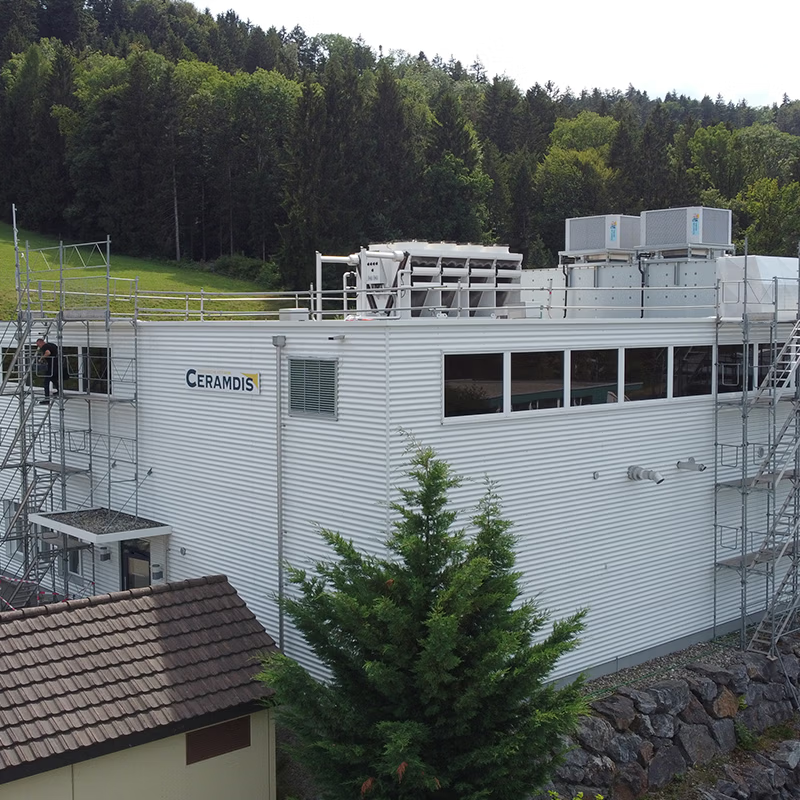
Ceramdis manufactures and processes technical ceramics. Extruders and sintering systems generate high internal heat loads in the production hall, with additional solar heat loads in the summer. For CNC manufacturing, a consistent temperature is essential to avoid fluctuations in production dimensions. Therefore, in 2023, a Sustainable Hall Conditioning system with four two-stage adiabatic coolers was implemented.
Following the exceptionally hot and humid summer of 2023, requirements increased: a maximum temperature of 25.5 °C and a relative humidity of no more than 65 % had to be maintained year-round. To achieve this, the existing SHC system was to be upgraded to hybrid operation. Installation had to take place during ongoing operations, and there were also strict noise control requirements.
The four two-stage adiabatic coolers deliver up to 56,000 m³/h of fresh air into the hall, with recirculated air added depending on the outside temperature and heat load. In 2024, the ventilation units were equipped with chilled water coils, supplied by a continuously variable chiller with a cooling capacity of up to 154 kW. It provides additional cooling and dehumidification as needed. Textile supply air ducts distribute the air without drafts. For noise control, the exhaust fans run at reduced speed at night.
The result: The hybrid solution combines high volumes of fresh air with defined temperature and humidity conditions, supporting stable production environments. The adiabatic system provides cooling as long as external conditions allow, with the chiller providing targeted support. Operating costs are up to 76 % lower than with a chiller-only system.
"Stable temperature and humidity conditions are crucial for our production. By upgrading to hybrid operation, we can continue to leverage the benefits of adiabatic cooling while ensuring the required facility conditions year-round."

Dominic Siegenthaler
Production Manager, Ceramdis GmbH
The customer company
Ceramdis GmbH is a Swiss family-owned company based in Elsau, specializing in high-performance technical ceramics. Since 1997, Ceramdis has been developing and producing custom ceramic solutions ranging from prototypes and small batches to large-scale production, and from individual components to complete assemblies, using materials including silicon nitride, silicon carbide, zirconium oxide, and aluminum oxide.
Learn more about this project
Download the best practice PDF for this project now – simply fill out the form and receive even more information.
synopsis
This project demonstrates how an existing Sustainable Hall Conditioning system can be specifically adapted to meet increasing demands. Instead of replacing the system, it was supplemented with active cooling. This resulted in a demand-oriented hybrid solution that continues to leverage the benefits of two-stage adiabatic cooling.
The benefits for Ceramdis GmbH:
- Max. 25.5 °C and max. 65 % relative humidity year-round
- High fresh air volumes of up to 56,000 m³/h despite active cooling
- Operating costs up to 76 % lower than with pure chiller operation
- Continued use of the existing SHC system
- Cooling and dehumidification according to actual demand
In short: Demand-oriented hybrid cooling for stable production conditions with high fresh air volumes.