
Indoor climate control in hybrid mode at Pilomat in Bergamo
Production facilities in the machinery, steel, and plant engineering sectors place high demands on year-round temperature stability and energy efficiency. At its Bergamo site, Pilomat opted for an integrated sustainable hall conditioning solution operating in hybrid mode. The goal was to ensure stable cooling and heating performance for two production areas, even with limited electrical capacity.
Please give your targeting consent to watch this video. By doing so, you agree that when you play the video, data will be transmitted to YouTube and collected by this provider.
Give targeting consent
- Industry: Mechanical, steel, and plant engineering
- Client: Pilomat S.r.l., part of the Hörmann Group
- Location: Bergamo, Italy
- Category: Sustainable Hall Conditioning
- Solution: Cost-Effective Cooling, Cooling with Photovoltaics, Heating
- KPIs: Fresh air flow rate up to 56,000 m³/h, hybrid operation with 2 reversible heat pumps, 114 kW cooling capacity per unit, 79 kW heating capacity per unit
- Year of completion: 2025
Project details
At the Bergamo production site, Pilomat faced the challenge of maintaining stable temperatures year-round in two physically separate production areas within a single building. During the summer months, high outdoor temperatures led to rising indoor temperatures, while in winter, uniform heating was required. Until now, there had been no integrated solution for cooling and heating, and at the same time, the site’s electrical power capacity was limited.
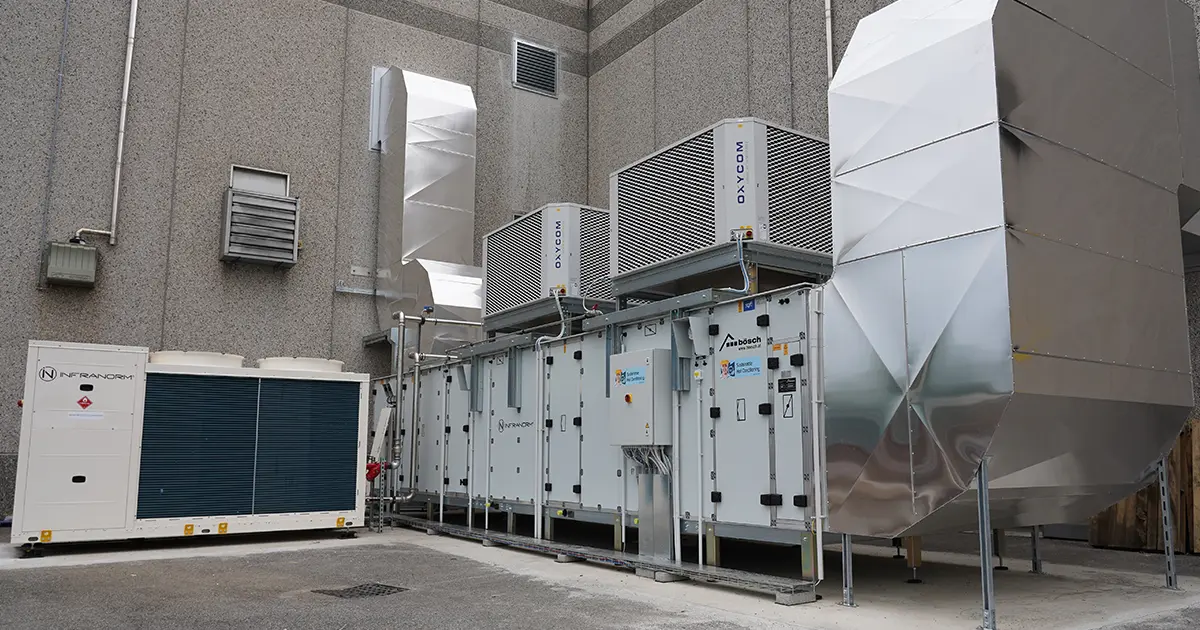
INFRANORM® therefore implemented a Sustainable Hall Conditioning solution in hybrid mode using two identical systems. Each system unit supplies a production area with a fresh air flow rate of 28,000 m³/h and enables targeted zone conditioning of the work areas. Basic cooling is provided by a two-stage adiabatic cooling system, which lowers the supply air temperature in an energy-efficient manner.
For peak loads or high outdoor temperatures, the adiabatic cooling is supplemented by reversible heat pumps. These provide additional cooling capacity and simultaneously handle heating during winter operation. This made it possible to completely replace the previously used gas-fired forced-air heaters. The result is a flexible hybrid concept that intelligently combines cooling and heating while taking the existing electrical infrastructure into account.
"For us, it was crucial that heating and cooling capacity could be reliably provided even during production-related peak loads, despite limited connected load. The hybrid concept with a reversible heat pump from INFRANORM® offered us a solution that was both technically and economically sound.”

Luca Frigeri
Project manager Pilomat S.r.l.
The customer company
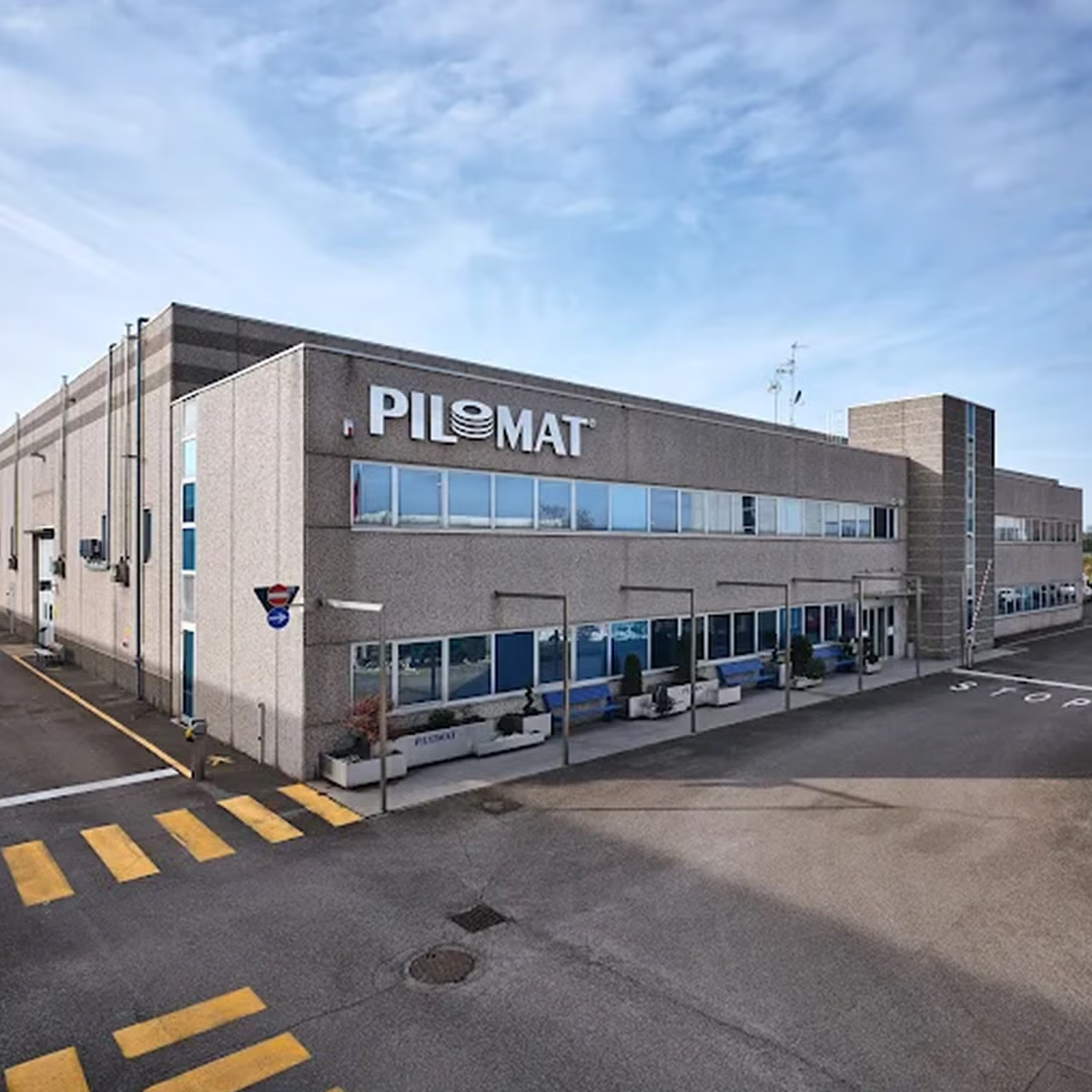
Pilomat S.r.l., based in Italy, is a manufacturer of automatic access control systems and security solutions. The company specializes in the development and production of automatic bollards as well as systems for controlling and securing access areas for industrial, commercial, and public applications. Pilomat is part of the Hörmann Group.
Learn more about this project
Download the best practice PDF for this project now – simply fill out the form and receive even more information.
synopsis
The project at Pilomat demonstrates that high-performance indoor climate control can be economically viable even with limited electrical infrastructure. By combining adiabatic cooling with reversible heat pump technology, a flexible hybrid concept was developed that delivers impressive results in terms of both energy efficiency and operational performance.
The benefits for Pilomat:
- Year-round cooling and heating capacity despite limited power supply
- Reduced peak electrical load through hybrid operation
- Energy-efficient use of adiabatic cooling
- Sustainable operation without fossil fuels
- Improved thermal comfort in the work areas
In short: Future-proof industrial building climate control that combines energy efficiency, production stability, and sustainability.